
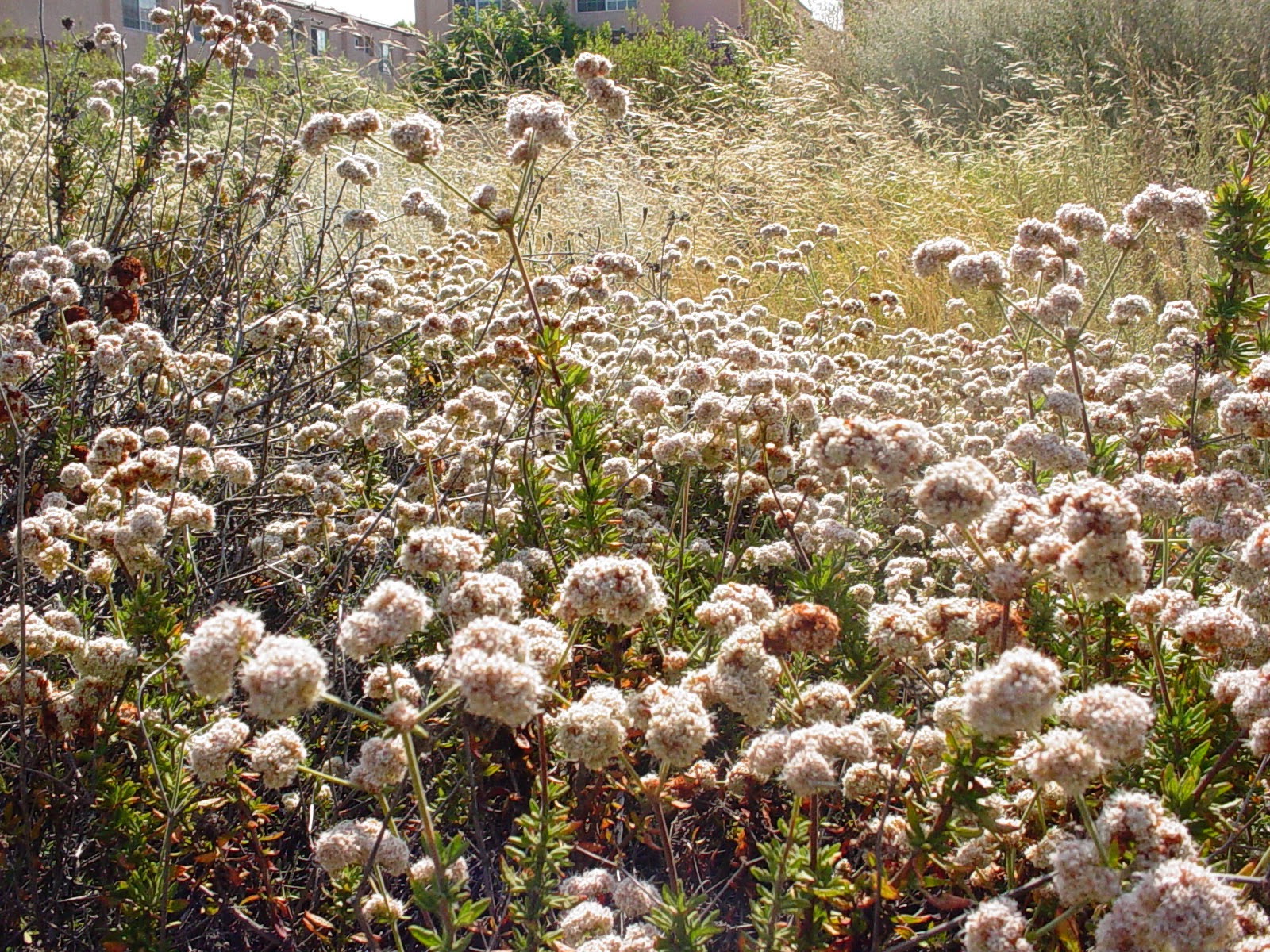
Guest author, Dan Songster, of the Orange County Chapter of the California Native Plant Society, submitted this Plant of the Month article for October featuring California Buckwheat.
- What: Eriogonum fasciculatum, California Buckwheat
- Type: Evergreen Shrub or Sub Shrub
- Light: Full sun to partial shade
- Soil: Likes good draining soils but is very adaptable
- Water: Drought tolerant
The Basics
California Buckwheat is our state’s most widespread buckwheat and is commonly found in both our chaparral and coastal sage plant communities. This low, evergreen shrub is often seen covering our hillsides in its lovely blooms for roughly half the year. Easy to grow with an interesting bloom cycle, this is one tough and dependable plant with so much going for it.

Plants have a moderate growth rate and are among the longer-lived native shrubs. Before it blooms, some say the plant reminds them of rosemary, but once it flowers, any resemblance is gone. The lovely and dense flower heads develop in walnut-size balls at the ends of branching stems from April to November. As blooms mature, they change colors from pale pink to cream, and by fall they turn a rusty brown which is often considered just as lovely as the paler blooms of spring. This rhythm of change is noted by Constance Vadheim “…the yearly cycle of the buckwheats – unchanging, unhurried and rhythmic – connects us to the earth and our Southern California natural heritage.”

There are three sub species of Eriogonum fasiculatum in Orange County. Read up on these and some of the beetles and pollinators that depend on this plant in Bob Allen and Fred Roberts’ indispensable book, Wildflowers of Orange County and the Santa Ana Mountains-Pages 353-56
Prevent Hillside Erosion
Buckwheat is perhaps the very best slope plant we have in California-Period. For those of us with a hillside to protect from erosion and weeds, California Buckwheat is ideal. Able to live well even on clay hillsides, it is fast growing, rarely exceeding 4 feet in height but can spread to be 8 feet wide if allowed. Often these branches arch outward and down and where they touch the soil, they sometimes root, making this one of our very best plants for stabilizing hillsides.

This dense plant is great at keeping weeds in check, but another advantage is the way it softens the impact of a rainstorm’s force on the soil. The close-knit foliage filters any hard rainfall, greatly softening its impact on the soil beneath the plant. Its roots hold the soil in place and each branchlet running along the ground slows soil from moving downhill.
Pollinators and Birds
If you have the room, the abundance of long-blooming flowers, drought tolerance, and its attractiveness to native bees, butterflies, and other insects make it a nice addition to any landscape. The flower clusters are extremely attractive to a very broad range of our native pollinators and are the larval host plant for some of our often overlooked smaller butterflies such as the Mormon metalmark, Gorgon copper, and many of the Hairstreaks and Blues. A California Buckwheat in bloom is a wonderful place to learn about our smaller, but very important (and lovely) pollinators.

This buckwheat also produces small, tasty seeds. On a fall day, it’s not uncommon to spot a group of seed-eating birds (finches, Dark-eyed juncos and towhees) near a garden buckwheat, enjoying the feast.
Smaller Gardens? If the somewhat large (wide) size of this versatile native is a deterrent to placing it in your landscape, perhaps one of the cultivars would fit? The cultivars are denser, more compact and often smaller by half. They include: ‘Dana Point,’ ‘Warriner Lytle,’ ‘Theodore Payne,’ and ‘Bruce Dickenson.’
Pruning
This is a very carefree garden plant and if given the needed space, some pruning is one of the only forms of maintenance you will need to do. When plants are young, some tip pruning of branches pointing upwards makes it a bit more prostrate and also denser. In garden beds, try not to plant it too close to sidewalks or garden pathways since this plant will invariably stretch into these sunny spots, blocking your walkways. At that point, nothing other than shearing will stop its spread. This harsh pruning does not really look all that appealing since removing the nice green of its foliage exposes the brown stems of the plant’s woody base.
The plant will often rebound from such pruning however if done in fall or early winter. I do selectively prune California Buckwheat when needed to keep it in bounds, but I do little else. Some people recommend pruning this buckwheat by cutting plants back to 4-6 inches above the woody part of the stem. That way it never looks butchered and has an easier time growing back.
Watering
California Buckwheat has a long taproot, allowing it to access deeper soil water. It also has shallower, fibrous roots. Buckwheat needs good winter/spring water to do its best. In fact, in a dry year, buckwheat does relish a deep watering about once a month to supplement the rainfall. The dry season can be a bit more challenging. California Buckwheat – and particularly the cultivars – are pretty forgiving with a bit of summer water, in fact they often respond well (holding their green color) with occasional summer watering – perhaps several times in a summer in western Southern California.

Indigenous Uses
Constance Vadheim, of Mother Nature’s Garden Blog states: “California Buckwheat is used medicinally where ever it grows. Native Californians and other Native Peoples use it primarily to treat headaches, stomach problems, diarrhea and wounds. Both the leaves and roots are used, fresh and dried. For colds, coughs, sore throats, and pre-menstrual bloating a mild tea is prepared. A stronger decoction from roots was traditionally used for diarrhea, stomach troubles, and to ‘clean the system.’ A strong tea from the leaves is reported to cure headaches and a decoction from young flowers is used as an eyewash. A poultice made from dried roots or fresh leaves and flowers was formerly applied to wounds. For medicinal uses, older established plants are reported to be more efficacious. The small seeds and young shoots are edible. The leaves were traditionally used to line granaries to keep acorns dry.”
Do you have California Buckwheat growing in your garden? Write back and share your experience with this versatile, evergreen, and long-flowering shrub.

Leave a Reply