
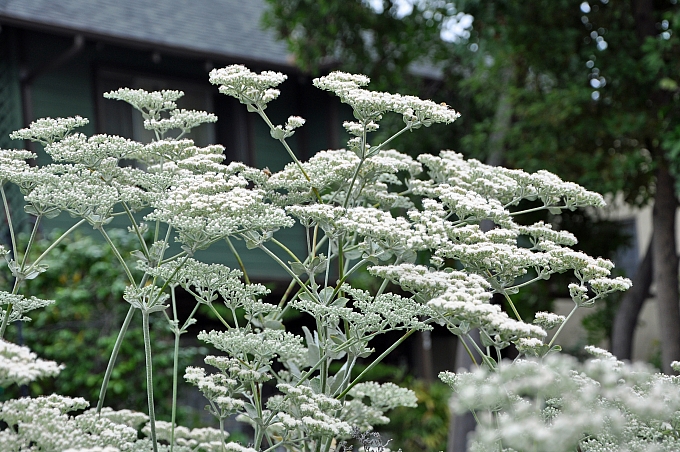
This article is written by guest author, Dan Songster, for the Orange County Chapter of the California Native Plant Society (OCCNPS). Each month, Dan features a California native plant and includes how to care for the plant as well as some interesting history. This month’s featured plant is St. Catherine’s Lace.
What: Eriogonum giganteum-Saint Catherine’s Lace
- Type: Evergreen shrub
- Light: Full sun preferred
- Soil: Good draining but adaptable
- Water: Occasional to rainfall only
The Basics
Out of the 125 species of Buckwheat in California, Eriogonum giganteum is California’s largest and perhaps showiest. This wonderful native from the Channel Islands is a must have IF you have the room in your garden for this stunner. Growing about 6 feet tall and 8 feet wide, even when not in bloom, it is an attractive plant with a freely branching rounded form with attractive woolly, gray, oval leaves. It can be left to grow in its “natural” shape or thoughtfully trimmed to form a small but wide garden “tree” of 5-6 feet tall. I think the old and gnarly bark is lovely when exposed in such a manner.

It is the flowers that make this plant such a showstopper, forming an umbrella over the grey foliage starting in May (sometimes even April). These giant umbels made up of hundreds of cream-colored flowers with soft pink overtones are bigger than dinner plates.
In some years, the plant is covered so thickly in these intricate lace-like clusters, you can barely see the foliage! One of our longest-flowering Buckwheat species, blooming continues for a few months, eventually fading to a rust color, and finally a dark chocolate color as seeds develop. Grow this native and you will not be disappointed.

Garden Uses
As expected from a Channel Island native plant, it loves coastal garden conditions even accepting salt spray. Surprisingly, it also does quite well in hot interior areas. This versatile plant is accepting of well-drained soils OR clay and is exceptional when placed on slopes.
I have seen it used as a single large focal point, a background plant in a large garden, a very informal hedge at Santa Barbara Botanic Garden, and even used in a generous-sized container. Certainly versatile, it can be used in many landscape situations–but I advise against planting somewhere thinking you will be able to prune it to keep it small. That may work for a while, but constant shearing will mean fewer flowers and an awkward looking plant.

It is nice to have a plant that is stunning when in bloom but also lovely the rest of the year.
Constance Vadheim writing in the Mother Nature’s Backyard blog says: “Some native plants look good all year long. Local gardeners depend on them as the seasons change from rainy spring to dry fall. One such garden stalwart is a large native Buckwheat commonly called St. Catherine’s Lace.”

You can imagine various plant combinations. For instance, plants that are big and green as a backdrop for St. Catherine’s lace silvery foliage, like Toyon or Coyote Bush. This shrub also looks great with any of the larger sages nearby, especially plants like Cleveland Sage, and evergreen shrubs like Ceanothus. Echoing the grey-colored foliage elsewhere in the garden, using plants like White Sage, Artemisia, or Catalina Silverlace can have a unifying effect–tying the garden together.
Care
St. Catherine’s Lace requires no summer water once established but young plants can accept occasional summer water to look attractive. They are highly drought-tolerant and can suffer from a reduced lifespan if overwatered, especially during summer. Be sure to let the soils dry out between watering.

They are fast-growing initially but slow down, forming large, woody, mound-shaped shrubs. When older, St. Catherine’s Lace branches can become brittle and with its eventual size and weight on the branches, it can be pulled apart, splitting near the base.
Pruning back to lighten the shrub each year when dead heading will help reduce that risk and keep them from becoming too top-heavy. This minimal pruning by cutting off old bloom stalks when the blossoms start to fall apart in early winter is usually all I do, just pruning a few inches into “end growth.” Often this is all the pruning that’s required. Remember, deep cuts into old wood is risky since the plant may not re-sprout from such harsh cuts. Removal of an entire branch to reveal the structure of the plant is fine however.

Notes
With its large and long-blooming flowers, St. Catherine’s Lace can be one of the most popular nectar sources for butterflies such as the California Blues and Hairstreaks, and all sorts of bees which are suffering from dwindling habitats. After the flowers begin to dry, the seed supplies local birds with food.
Speaking of flowers, they make very nice cut material in both dried and fresh arrangements, often retaining their color when picked–creamy white in May or rusty cinnamon in August.

While it may be considered to be a “long-lived perennial shrub,”, I must say that in clay soils (where I do my gardening), plants average around a ten-year lifespan. I sometimes allow a nearby chance seedling to grow and take its place when the original parent plant’s foliage begins to thin and its flowering slows or shows signs of decline.
Special Note: Is St. Catherine’s Lace too big for your garden? Although I have never grown it, if you ever run across a smaller variety named Eriogonum giganteum var compactum, sometimes referred to as Santa Barbara Island Buckwheat, it would be worth a try. I am not sure why but it is not normally found in nurseries (CNPS’s Calscape site shows only three nurseries in the state carrying it). If you have a smaller garden and you come across this plant for sale, why not try it? And if you find it, please let me know where!
Leave a Reply