
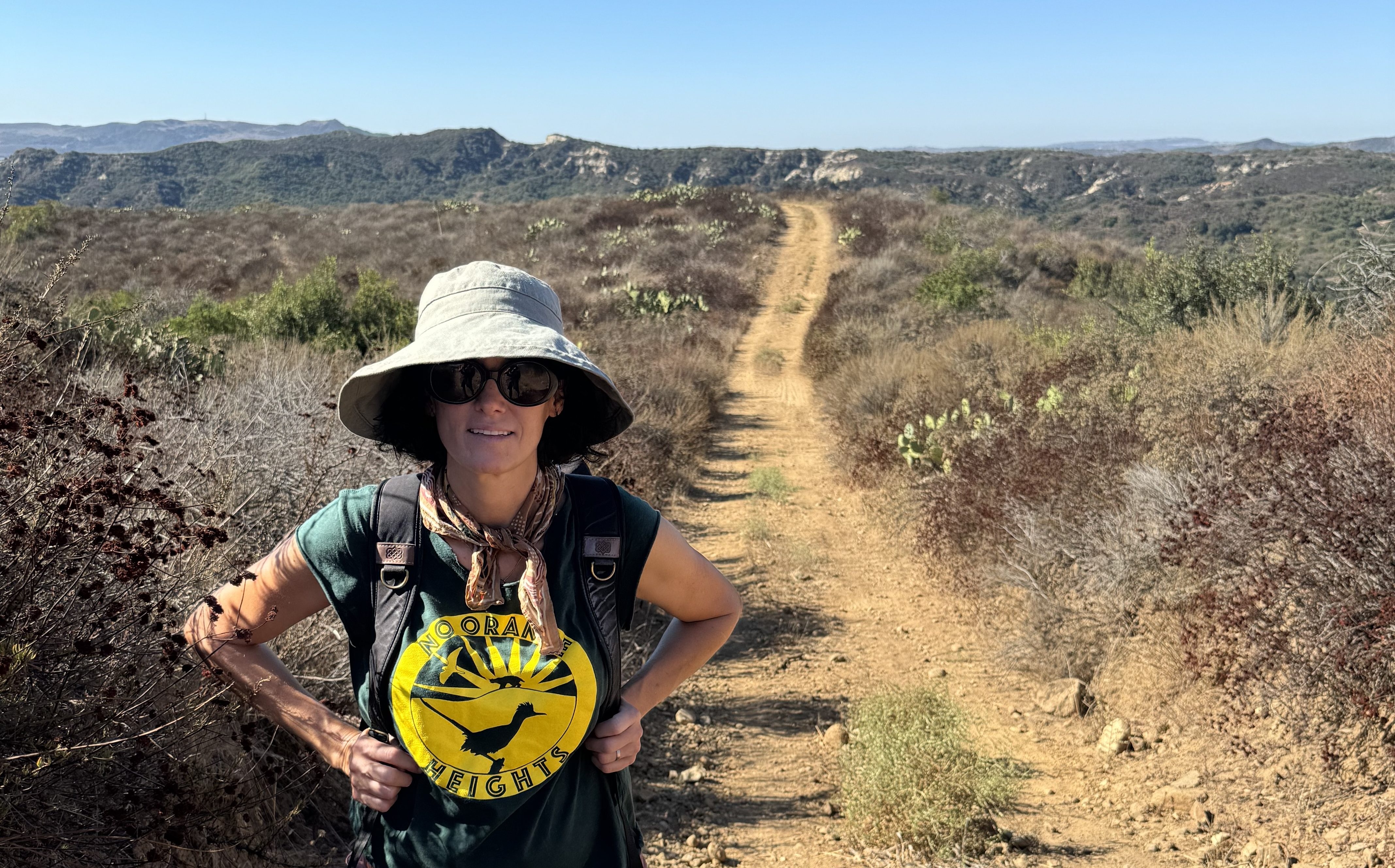
Thea Gavin compiled this bio featuring Karen Graham, the newest board member to join the Orange County Chapter of the California Native Plant Society (OCCNPS).
Board member Karen Graham brings a wealth of educational experience and community connections to OCCNPS. With a California Teaching Credential and decades of teaching, teacher training, and curriculum writing experience, she also holds certificates in the following areas: UC California Naturalist, Life Lab Garden Educator, and Permaculture Design. This extensive background serves her well in her current role as Lead Instructor and Program Director at Earthroots Field School in Silverado Canyon.

The Impact of Native Plants
Two years ago, Karen and her husband Jason attended a Vera’s Sanctuary tour and she was deeply inspired by the experience.
“We initially went for home garden ideas, but seeing how thoughtfully native plants were integrated and how the space supports the women who live there was incredibly moving. That experience encouraged me to begin volunteering with CNPS, attend meetings, and learn more about native plant advocacy.
“I now visit the women at Vera’s Sanctuary monthly as a volunteer, where I teach nature-related classes that include crafting with plants, gardening, and cooking. Elizabeth Wallace has also been a generous mentor as I’ve navigated native plant advocacy within my HOA.”
As Program Director at Earthroots Field School (a nonprofit environmental education organization), Karen works to bring ecoliteracy education into local schools. To that end, she has written curriculum that bridges nature-based learning with public school standards. Each week she teaches hundreds of students nature-based lessons—outdoors—on public school campuses across Orange County.

“Native plants are a central part of this work, especially in helping students understand how to support biodiversity in their local ecosystems. At Earthroots, we also partner with Indigenous communities, including the Acjachemen people, who have longstanding relationships with these plants. When we teach about native plants, we emphasize the deep cultural knowledge and history that Indigenous communities have carried for generations.”
Karen’s Roots
As is the case with many native plant enthusiasts, Karen’s “botanical origin story” goes back to her childhood.
“My most vivid early childhood memories are rooted in being outside—running through sprinklers, roller skating around my neighborhood, or spending time in my Nana’s garden. My grandmother loved her plantitas. She spent her mornings outside, whistling as she tended her plants, always proud to show others how happy they were growing. Spending time in her garden and watching how much joy she found in being with her plants left a deep impression on me, even before I had words for why it mattered.”
Later on, in her teens, Karen moved to Olympia, Washington. “That’s where I fell in love with the forest. Being immersed in the forest, with its cool air and familiar scents, gave me a sense of comfort and longing to be in nature that has stayed with me ever since.”
When Jason, her future husband, introduced Karen to camping when they first started dating, “I was hooked. Twenty-five years and four kids later, we still spend much of our free time outdoors together. Over time, that love of being outside grew into curiosity about the plants around us, and eventually into a deeper interest in native plants specifically.”

“Doug Tallamy’s books have been hugely influential in shaping how I think about plants and ecosystems. I’m also grateful for my colleague Shane Brown at Earthroots, who designed and installed our rain garden and has been a generous plant mentor and friend over the years.”
Inspiration—And Native Plants—For All
Like many teachers, Karen is a lifelong learner, and her native plant journey has involved soaking up native plant knowledge through classes, talks, local events, and learning by doing. “I especially enjoy Joel Robinson’s ‘Naturalist for You’ classes.”

Now her yard is planted mostly with California natives. “I have rain gardens in both the front and back, with mulch basins and a rain tank (for the vegetable garden) fed by rainwater and roof downspouts. Almost all the rainwater that falls on our property stays on our property, and most of the yard only gets supplemental hand watering.
“Having native plants around my home has helped me understand them more deeply through regular care and observation. One idea that has really shaped my thinking, often emphasized by Doug Tallamy, is that our everyday landscapes matter. Our OCCNPS chapter works to emphasize that message as well: native plants aren’t just for preserves or wild places; rather, they belong where we live, work, and play, and even small changes can make a difference.
“I want people to understand that you don’t have to be a native plant expert to start. I sure wasn’t. Even simple swaps like replacing one Mediterranean plant with a California native or sprinkling a few native seeds into your existing garden palette can make a difference. Noticing what is happening with your plants seasonally, when certain plants flower or go to seed, what insects arrive, or which birds stop by can be incredibly rewarding. Some of my favorite moments are when curious neighbors stop by to ask about our garden. They tell me they can smell our yard (the sages) before they turn the corner and wonder what the different plants are called.”

HOAs Need Native Plants Too
As a nest box monitor with the Southern California Bluebird Club, Karen has seen firsthand how landscaping choices affect local insect life and bird populations. “I realized that my home was one of the few in my neighborhood with California native plants. That inspired me to join my HOA board and advocate for including native plants in shared spaces. So far, we’ve installed one common area with native plants. It hasn’t always been easy. Turf removal and changes to the plant palette can be controversial, but the work feels worthwhile, so I carry on. I also write quarterly articles for our HOA newsletter to help neighbors learn about the value of native plants and how they support biodiversity in our community.”

OCCNPS Goals
“As a member of the OCCNPS Education Committee, I hope to support efforts that expand access to native plant education in communities that may not have easy access to natural spaces.
“I would also like to support more collaboration with local Indigenous communities, including inviting Acjachemen and Tongva voices into OCCNPS events as guest speakers, advisors, and teachers.”
Crossover Work
“I also work with school gardens—currently nine—supporting farm-to-school programs that connect students to gardens and healthy food.”

Favorite CNPS Activities
“I loved participating in last year’s OCCNPS California in My Garden tour! It was so much fun to meet people and spend the day talking about plants and my garden. I also really enjoy CNPS classes and meetings and always leave having learned something new. I’m looking forward to my second CNPS Conference in Riverside this February; it was such a positive experience the first time.”
Wisdom to Share
“I still consider myself a learner when it comes to native plants. One thing I’ve learned is the importance of gentleness when inviting others into this work. Change can be hard, and everyone comes with different values and constraints. Helping people feel curious, and showing how native plants can fit into their own lives in meaningful ways, can go a long way.”

“I didn’t expect native plants to feel so ‘edgy’ or challenging for some people, especially within HOA contexts. Learning how to integrate natives into more conventional landscapes has been a process of trial, error, and patience. Along the way, I’ve also learned a great deal about traditional plant uses through classes with Indigenous teachers, at primitive skills gatherings, and by daily interaction with my own garden. I have learned how to connect with the native plants in my yard as I use them for crafting, food, basket weaving, and medicine.”
A Full Circle
“In many ways, this journey feels like coming full circle, from watching my grandmother care for her garden as a child, to tending my own plants today and sharing that love with students, neighbors, and the CNPS community.”

Leave a Reply