
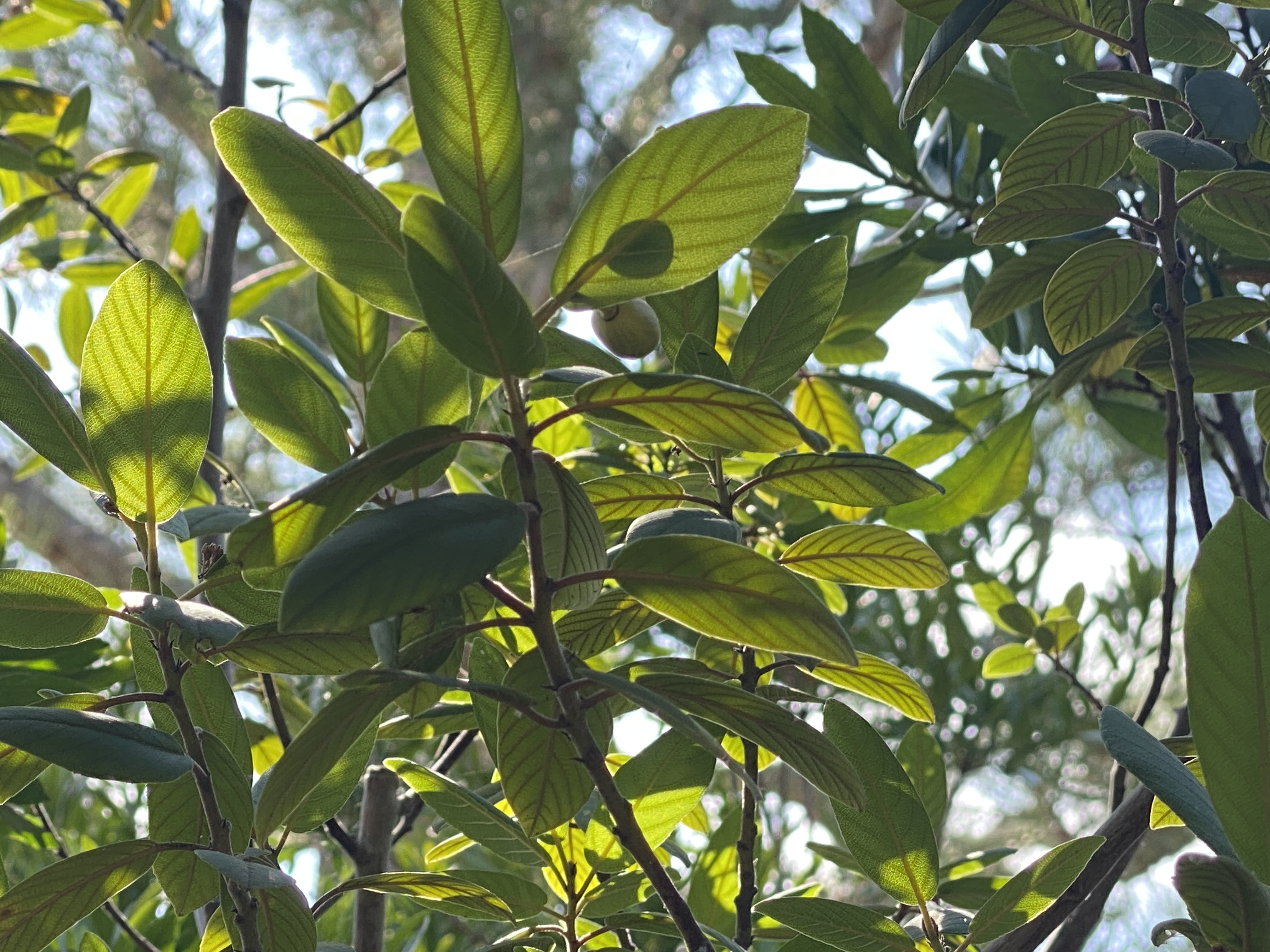
Guest author Dan Songster writes about the cool, green backdrop coffeeberry provides as a foundation plant in the native garden during the hot summer months.
Frangula californica-California Coffeeberry
- Type: Evergreen Shrub
- Light: Sun to Shade
- Soil: Adaptable
- Water: Drought tolerant but can take/enjoy occasional water
Summer and fall in our native gardens can be a bit less colorful than spring, but we do have some color reminding us that summer is not completely without flowers. The pastels of the beach aster, the bright yellows of the goldenrod, the hot orange-red of the California fuchsia, and the exotic orchid-like flowers of desert willow are a few summer bloomers.
These are the seasons of rest for much of the garden and genuine native plant lovers understand that their gardens take a breath at this time. This is when the solid greens of plants like the long-lived coffeeberry stand out with a refreshing coolness and provide an anchor for a garden’s design.

Besides the “straight” species which tend to be fairly large, there are also several named varieties. Various coffeeberry cultivars can grow 2-3 feet tall and 3-4 feet wide. From the low growing ‘Seaview Improved’ and ‘Little Sur’ to the midsized ‘Mound San Bruno’ and ‘Leatherleaf’ to the taller forms like ‘Eve Case’ and ‘Bonita Linda,’ coffeeberry can suit every garden.

‘Bonita Linda’ has a more open habit that makes it a great living trellis for Keckiella cordifolia (heart-leaved penstemon) to climb in. ‘Mound San Bruno’ is a dependable middle green, and ‘Leatherleaf’ is the darkest leaf of all. It actually looks black when the sun is about to set.

This versatile and forgiving plant is normally left untrimmed and provides a mound of lush green as a foil for lighter-leafed plants, especially plants featuring gray and silver leaves. Alternatively, it can be trimmed into a hedge if needed. Coffeeberry can be used in sun along the coast or in dappled or fairly dense shade inland.

Water in summer? Coffeeberry usually does not mind but can also take weeks with no water once mature. Clay soils? It can usually handle heavy soils without problems. It is this adaptability that makes coffeeberry one of my all-time favorites to use and to recommend.
Pests? Nothing much bothers it, but I must mention Argentine ants. I imagine that Argentine ants can be a problem for this plant as it is to its cousin, the Ceanothus (and many other native plants). These non-native ants “farm” scale insects by moving them around on the plant and even down onto root systems where the scale can set up colonies which suck the life out of the plant. A remaining question is whether it is this simple desiccation/sugar appropriation that is the cause of a plant’s collapse, or whether it is the pathogens that researchers have found to be spread by this activity. Greg Rubin has posted information and suggestions on combating Argentine ants.

Coffeeberry forms berries that resemble those of a coffee plant (hence the common name). There is a debate about whether these berries are toxic to humans. (Some folks make a coffeelike beverage from the seeds without ill results. Please do your own research.) They are extremely attractive berries that add a layer of color lying at or slightly below leaf level in summer/fall months.
There is a desirable richness of the dark green leaf with ripening berries that range in color from lime green to rose, red and finally burgundy and almost black. Seeds mature in the fall and seed dispersal is performed by birds which are attracted to the fruit, thus, seedlings will pop up from time to time in your garden.

California coffeeberry is a great plant for insects, being a nectar plant for many butterflies such as the Pale Swallowtail, Variable Checkerspot, American Lady, Mourning Cloak and more. Butterfly expert Arthur Shapiro notes that coffeeberry “tends to be excellent for small butterflies with short tongues, especially hairstreaks.”
Jeffrey Allen Caldwell, author of California Plants as Resources for Lepidoptera:
a Guide for Gardeners, Restorationists and Naturalists, states: “California coffeeberry supports butterfly caterpillars, such as the Pale Swallowtail, Gray Hairstreak, and Echo Blue.” He mentions that “Marc Kummel photographed a Brown Elfin ovipositing on the flower buds of California Coffeeberry.” Hmmmm, would the larvae actually hatch and feed on the coffeeberry? More research needed.


Leave a Reply to E. WallaceCancel reply