
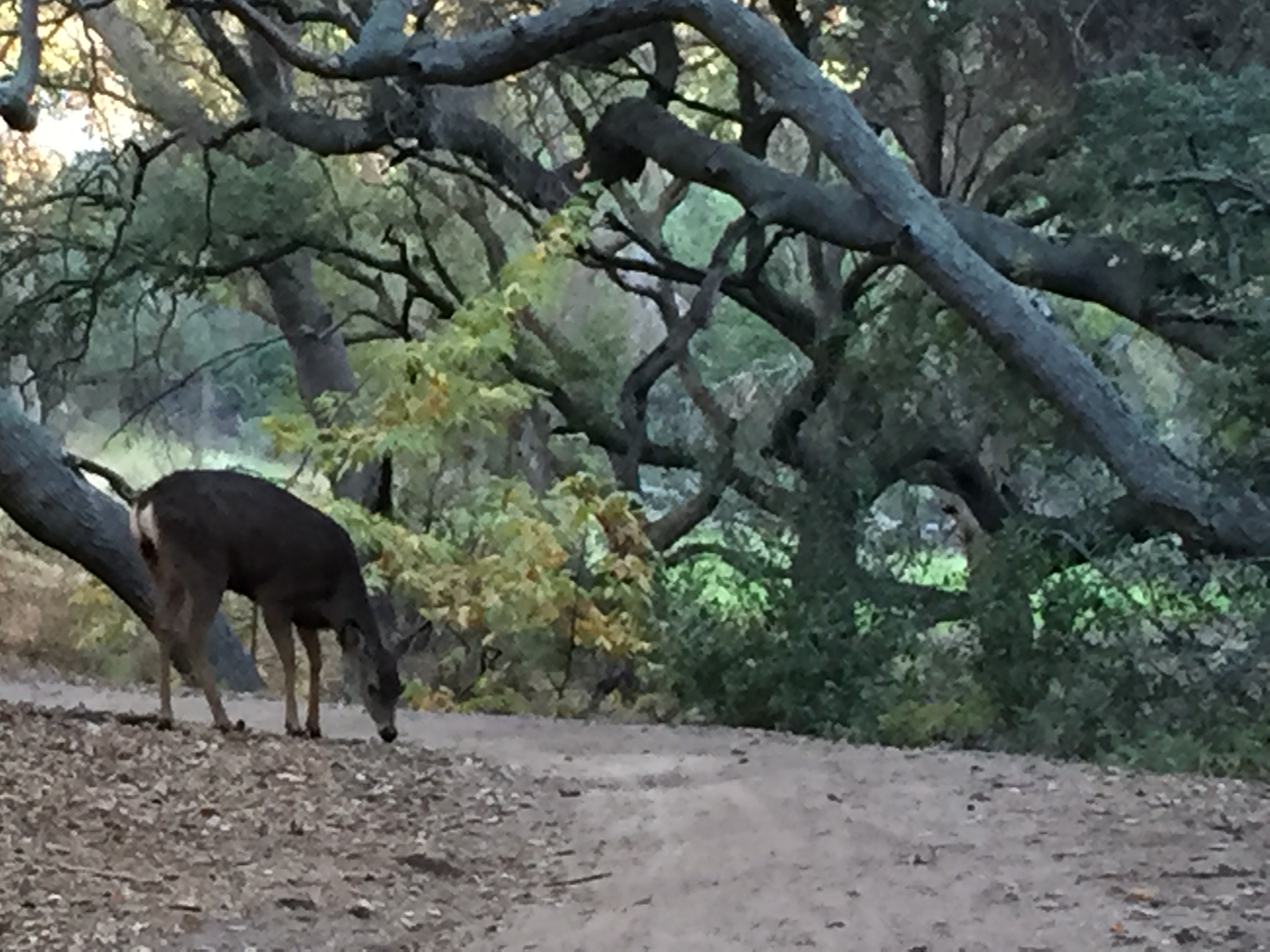
In this Plant of the Month feature, guest author Dan Songster highlights the Coast Live Oak for the Orange County Chapter of the California Native Plant Society (OCCNPS) July newsletter.
- What: Coast Live Oak (Quercus agrifolia)
- Type: Evergreen Tree
- Light: Sun, but can easily take a touch of shade
- Soil: Likes fair to good draining soils but does well in clay
- Water: Infrequent to drought tolerant

This wonderful tree may be prettier when the rains wash the leaves a glossy dark green in the winter, and it is certainly lovely when cloaked with drooping little catkins of flowers and new pinkish growth in the spring. But even during the driest and hottest summer days, the coast live oak shows off its evergreen abundant foliage, providing shade and a cool respite underneath its canopy.
The coast live oak is native to California and Baja, and thrives in our climate characterized by mild, wet winters and hot, dry summers. It is the most commonly observed oak in our local area and it is easy to find in canyons, coastal hills and plains, near creeks, and in shaded areas.

Coast live oak trees bring a soothing dark green hue to the golden hillsides of summer. The oil paintings of early California done by Granville Redman and William Wendt are timeless studies that illustrate our golden hillsides cloaked with the sturdy, noble structure of our native oaks.
Coast live oak stands are 40 to 110 years old, and individual trees may live more than 250 years, ranging in height from 20 to 70 feet and about as wide or wider. Trunk diameter can range from a modest one foot to four feet in really old specimens. The bark of young trees is smooth, but with age it develops furrows, ridges, and thickness. The tree’s crown is broad and dense, with foliage often reaching the ground in the wild (unless grazed by livestock or deer).

In gardens, we normally lift the lower branches to be able to see the oak’s lovely branch structure and to have a place to sit on a hot summer day. Acorns form in the late summer and were once a major food source to the indigenous California tribes who enjoyed their bounty.
Obviously, this tree would be too large for small gardens, but in larger landscapes I have often wondered why they were not used much. When the re-landscaping of the 5 and 22 freeways occurred a few years back, there were many other trees installed but none of these beauties. What a lost opportunity to bring back some of the character and beauty of Orange County that has been lost over the years to development.

Happily, coast live oak trees are now used more frequently in parks and in larger community gardens. In fact at Golden West College, the Learning Resource Center has a group of native oaks on the north side of the building.
Coast live oaks are not as slow growing as some believe and although they are not a showy flowering tree, what great structure they have!

If you plant anything under a native oak, make sure it does not need heavy summer water, because oaks do not like to have wet roots during warm weather. The combination of warm soils and water can promote root rot in the tree.
Otherwise, coast live oaks are as easy to care for as most tree species, native or exotic, planted in southern California. If you would like to see one that was planted in 1975, simply visit the center area of the garden at Golden West College. Spend some time looking up into its canopy of holly-like leaves. It is a serene and beautiful scene.

Author’s note: In the last several years, the Polyphagus Shot Hole Borer has become a problem for coast live oaks as well as many other trees in Orange County, both native and exotic. The shot hole borer inserts a deadly fungal pathogen into the tree’s vascular system. While there is no cure yet, there are treatments that allow infested trees to live and prosper. Currently, repeated treatments are needed every couple of years for trees that are attacked by this borer. Not every tree is attacked, but if evidence of the borer is found in any of your trees, you might considering researching more information here and at this site.
You can learn more about coast live oak trees at Calscape.org.
Leave a Reply