
This article was submitted by Ron Vanderhoff, Plant Science chairperson and board member of the Orange County chapter of the California Native Plant Society (OCCNPS).

By mid-morning the heat was already pushing 100 degrees. There was no trail to follow—only dense chaparral, steep rock outcrops, and the occasional opening that suggested we were still on course. Every few hundred yards we stopped to reorient ourselves before plunging back into the brush. The four botanists hiking with me had traveled from the Santa Barbara Botanic Garden and the Cleveland National Forest for a mission that only a handful of people have ever experienced: visiting one of California’s newest and rarest native plant species. Growing just outside urban Orange County, we were about to visit a plant that fewer than a dozen people have ever seen in its natural habitat.

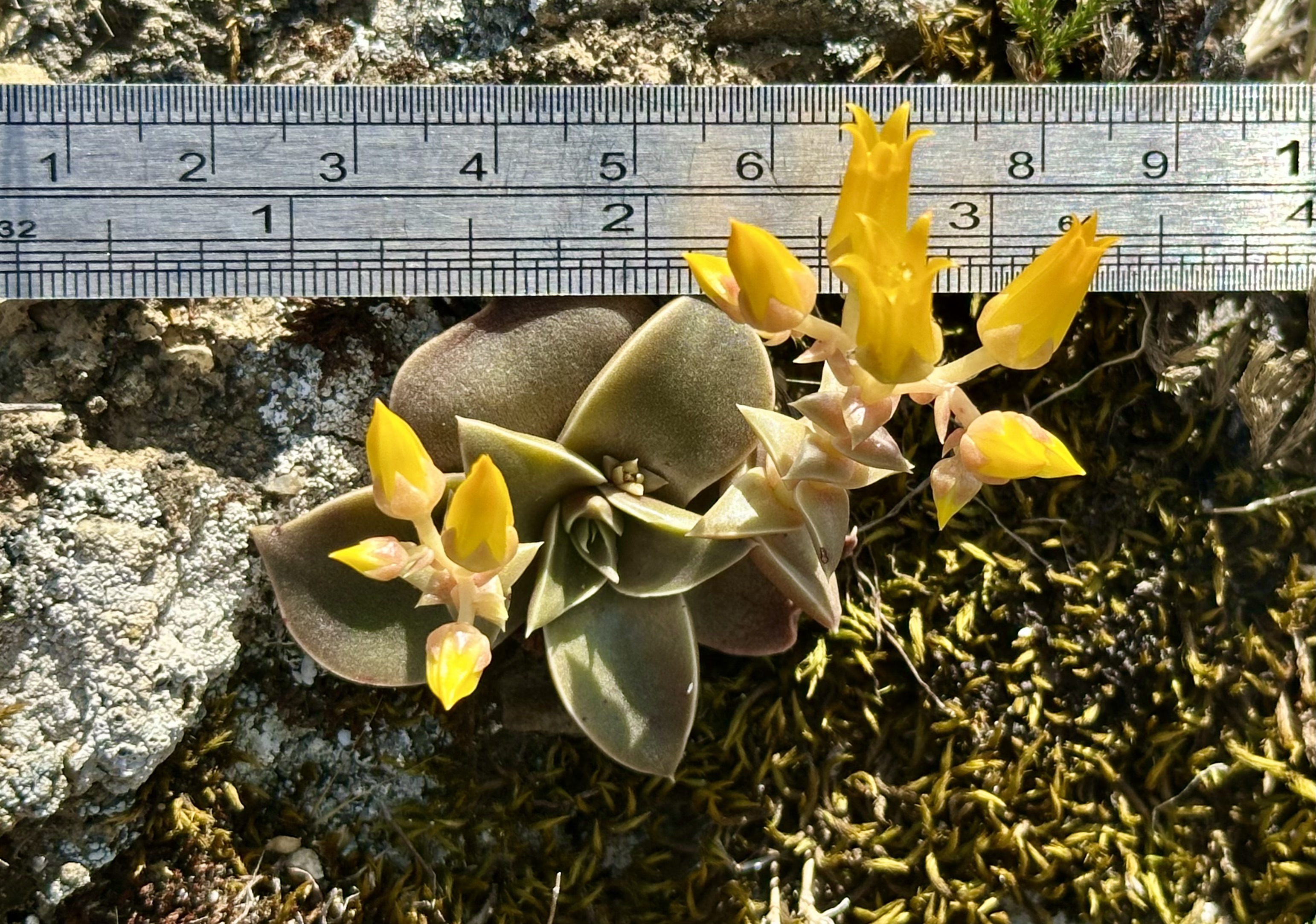
Hidden beyond a couple more ridges and out of sight, at a location in the Santa Ana Mountains that remains intentionally undisclosed for conservation reasons, grew Dudleya chasmophyta.
Formally described as a new species in 2023, this remarkable succulent is one of California’s newest recognized native plants, one of only two vascular plant species endemic entirely to Orange County and assigned a California Rare Plant Rank of 1B.1, the highest level of rarity recognized by the California Native Plant Society. Although it has not yet been proposed for protection under the federal Endangered Species Act, its extremely limited distribution of a single continuous occurrence occupying only about two acres makes the plant one of the rarest in the state.

Joining me on July 16, 2026, were Chloe Tilton and Isabela Lima Borges of the Santa Barbara Botanic Garden, together with Lauren Quon and Katya Hernandez-Pol of the U.S. Forest Service’s Cleveland National Forest. Our objective was not simply to admire this extraordinary species. We were there to collect seeds that will become part of the Santa Barbara Botanic Garden’s long-term conservation seed bank, helping safeguard the species for future generations.
For me, however, this expedition represented far more than a seed collection trip. More than fifteen years ago I relocated and began monitoring this population, returning repeatedly through different seasons to record measurements, and document its distribution, flowering, habitat, and ecology. Over the years, through numerous conversations with Dudleya expert Stephen McCabe, it became increasingly clear that these plants represented something unique.
This colony was originally located by Kei Nakai in 1979 and presumed to be a taxon of the quite variable species, Dudleya cymosa. But it never quite fit with the many subtaxa of that species. After years of speculation, in 2023, we assembled an expert team that included Stephen McCabe (UC Santa Cruz), Matt Guilliams (Santa Barbara Botanic Garden), Mark Elvin (CDFW), Jenny Moore (USFS), and noted California botanist Fred Roberts.
Having the most experience with the colony, I led them to the plants and we collected the specimen that ultimately became the nomenclatural standard upon which the species description was based, known as the type specimen.

Back at the Santa Barbara Botanic Garden, conservation geneticist Kristen Hasenstab-Lehman performed the genetic sequencing, and a scientific paper was ultimately written and published in the California Botanical Society journal Madroño, describing the new species.
The publication of Dudleya chasmophyta in 2023 as a new species was not the result of a single exciting discovery, but of years of careful observation, collaboration, and research by numerous dedicated botanists. Having had the opportunity to contribute to that process has been one of the most rewarding experiences of my botanical career.

Standing among the plants on July 16 felt like another milestone in that continuing story. Instead of documenting flowers or photographing plants, we were now taking an important step toward securing its future.
Seed collection for rare plants follows carefully developed conservation protocols. Mature flower heads are collected from numerous plants, carefully numbered and recorded, to capture as much of the population’s genetic diversity as possible while leaving the majority of seed in the wild to sustain the natural population. Every collection is meticulously associated with its maternal plant so that its origin and genetic lineage remain permanently associated with the preserved seed.

The seed collected during our expedition will now be cleaned, processed, tested, and ultimately stored under long-term cryogenic conditions at the Santa Barbara Botanic Garden. These collections provide an invaluable insurance policy against catastrophic wildfire, prolonged drought, disease, or other unforeseen events. They also preserve opportunities for future scientific research and, should the need ever arise, restoration of wild populations.

As climate change, increasingly frequent wildfire, invasive plants, and habitat loss continue to challenge California’s remarkable flora, conservation seed banking has become one of the most important tools available to botanists. Protecting species in their native habitats will always remain the highest priority, but preserving genetically representative seed collections provides an essential second line of defense.
Looking back over the past fifteen years, it is remarkable to consider the journey of this little-known plant. From a poorly-understood population hidden on remote cliffs in the chaparral, to formal recognition as one of California’s newest and rarest native species, and now to the security of a permanent conservation seed bank, Dudleya chasmophyta reminds us that there are still extraordinary botanical discoveries waiting to be made—even in one of the world’s most thoroughly explored floras.
This story, however, is not finished. Continued monitoring, habitat stewardship, scientific research, and perhaps one day formal legal protection will all play important roles in the future of this remarkable Orange County endemic. I hope that many years from now, future botanists will still make the same challenging journey through the chaparral—not because the species is disappearing, but because it continues to thrive in the rugged landscape that has protected it for thousands of years.

Ron Vanderhoff can be reached at rareplants@occnps.org.


Leave a Reply