
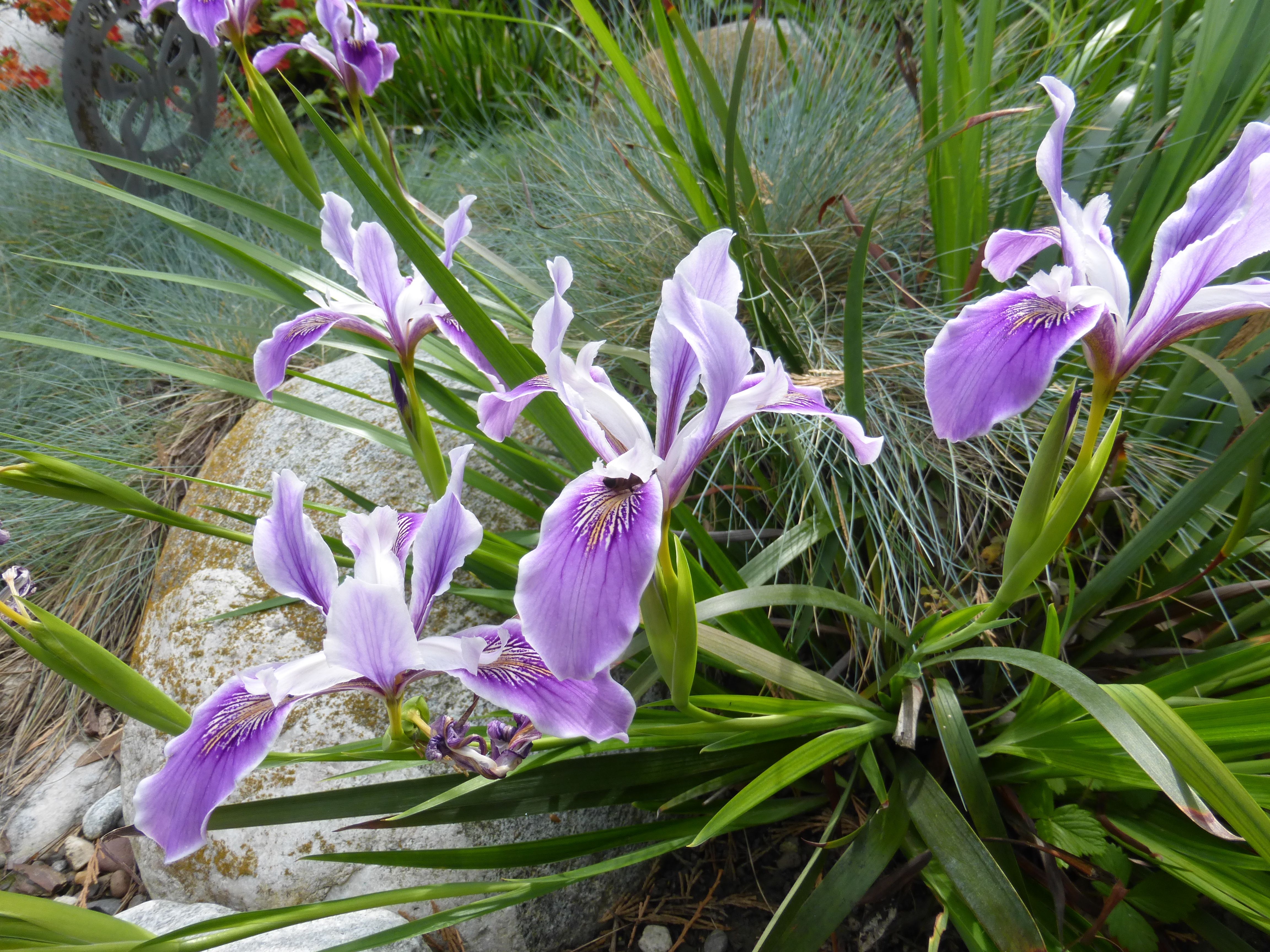
Guest author Dan Songster, former president of OCCNPS, submitted this article highlighting Douglas Iris as the Plant of the Month for April.
- What: Douglas Iris, Iris douglasiana
- Type: Mostly evergreen, herbaceous perennial
- Light: Sun to partial shade
- Soil: Well drained preferred, but adaptable
- Water: Infrequent

The Basics
This is a plant that is native from central coastal California to Oregon, with its southern distribution extending nearly to Santa Barbara. It is quite tolerant of a wide range of growing conditions and it is simply a wonderful and distinctive native to grow. Of all the native irises of California, it is the Douglas Iris that works best in our gardens here in Orange County.
Often found in coastal grasslands, this iris has narrow, one-and-a-half to two-feet-long dark green leaves, and along with its rhizomes, this plant forms a 2-4 foot-wide clump. Flower stalks push slightly above foliage with the light purple, lilac, or even light blue to cream-colored flowers. Although its lovely spring flowers are enough to recommend this plant, it is also widely used because of its fountain-like evergreen foliage.
In the Garden
Douglas Iris is a versatile garden performer–a wonderful addition to formal or informal gardens. If grown in masses or used as a bedding plant, individual plants should be spaced approximately 30 inches apart. It can also simply be placed here and there in most gardens, providing a point of interest near a boulder or log.

I often see it planted in woodland settings as part of oak understory plantings (imagine it combined with plants like the Pink Flowering Currant, Meadow Rue, Coffeeberry, Columbine, and Coral Bells), near patios or walkway intersections where its lovely foliage and springtime flowers can be appreciated year round.
My favorite uses are either planting it along with native grasses and bulbs, as a part of a meadow landscape, which reminds me of the grasslands of Marin Headlands, or planted along the edges of the swales in rain gardens where they resemble huge sedges until the flowers explode of course!
Soil and Environment
Douglas Iris prefers part or full shade and though tolerant of clay soils, prefers richer and better-draining soils than the normal clay often found in Orange County. Efforts to improve heavy soils with pumice, decomposed granite, and even peat moss or other organic materials can help this garden favorite stay healthy and beautiful. It likes summer water every 2 to 4 weeks. If planted very near the coast where it benefits from cooler temperatures, it enjoys full sun or dappled light. Douglas Iris does best with partial shade to almost full shade inland where temperatures are higher.

Maintenance
It is normal for the tips of the foliage to discolor with age and they can be pruned (not pulled) off if objectionable. Listed by most authorities as a true herbaceous perennial, Douglas Iris tends to die back (at least partially) to the crown each winter and reemerges from the base each spring. So, depending on weather, where you live, and the moisture levels in your garden, don’t be alarmed if you have leaves dying back in winter.
As with other irises, slugs and snails eat flowers but do not damage the vegetative parts of the plants much. Not much more is required other than keeping the weeds (especially the grassy weeds like Veldt grass) out of it. Some people pick off the dead blooms, but leaving some flowers to become fruitful with seed means seedlings for your garden, which can be shared with your gardening friends or moved to other spots in your landscape.
Propagation
As with all irises, the planting will look better if the clump is lifted and divided every few years. Douglas Iris is best propagated by division in fall or winter (Nov–Jan). Divide established, crowded clumps by lifting them and pulling apart with healthy, white roots, ensuring each section has roots. Replant shallowly, allowing the rhizome to be near or visible at the soil surface. As with all new plants, water them until well established. Seeds are easy to grow when started in the fall or early spring and take about two months to germinate. Thirty days stratification in the refrigerator will help break dormancy, but sowing in flats and leaving them outside in the winter weather will also give good germination.
Canyon Snow
Iris douglasiana ‘Canyon Snow’ is an exceptional plant in both garden durability and in flower color. This is a selection was introduced by the Santa Barbara Botanic Garden in the late 1970’s by Dara Emery. With its pure white petals with butterscotch yellow veins in them, it is beautiful whether close up or from quite a distance. Other than the normal Douglas Iris, it is probably the most well-known of all the irises we use in southern California.

Hybrids
Over the years many iris of various parental combinations have been chosen and named but are often lumped under the label PCH, which stands for Pacific Coast Hybrids. Although there are many named hybrids, unless you shop at specially online nurseries for them, you will likely only find them listed simply as Pacific Coast Hybrid (PCH) iris, so you may not know what you are getting in color or flower shape.
These hybrids are bred for larger more colorful and showy flowers but the plants themselves can be less vigorous than the straight Douglas Iris. For me in heavy clay soils, they just do not last long. But if you take the time and energy to work your soil up to a lovely garden style loam, perhaps that spot can be a place to try all the iris hybrids your heart desires. (See Soil Prep for Hybrids below.)

Even in heavy soils, I still use them occasionally for the short show of color and for our own desire to see what unexpected colors will emerge during the spring bloom. If you choose to grow these hybrids, there can be rewards beyond the beauty of the plant you purchased and planted when seeds fall and new plants sprout.
Regarding “natural” hybridization in the garden, Liz Parsons, of the Milo Baker CNPS Chapter, grows these hybrid Irises and states, “Plants will re‐seed and, if you grow several different species, you never know what new colors and flower forms will appear. My garden is filled with chance seedlings that give a spring surprise when I see the new flower colors.”
Soil Preparation for Hybrids
Here in southern California, if you are serious about growing some of the hybrid cultivars of Douglas Iris with their imaginative names and colorful, frilly, and large flowers, then special soil preparations are helpful.
Richard C. Richards in an article for the Society for Pacific Coast Iris newsletter writes, “Good soil preparation can make the difference between excellent growth, or little growth followed by sudden death. Most soils in southern California are alkaline and need to be altered to neutral or slightly acid. This can be done in several ways. One is the addition of soil sulfur, applied at 5 lbs. per 100 square feet. Another involves adding copious quantities of peat moss – spread it on the soil at least two inches deep and spade it in. Using both soil sulfur and peat moss is better than using only one, and the soil sulfur adds grit to the soil.
Most soils in southern California are heavy, usually clay or adobe, and need to be lightened considerably. Soil sulfur and peat moss will help, but with heavy soils the addition of gypsum at the rate of a pound per square foot is also recommended. You do not need this if your soil is already light, sandy, or gritty. In that case just add even more peat moss.”
Is Douglas Iris growing in your garden? Write us back and share your experience.
Leave a Reply