
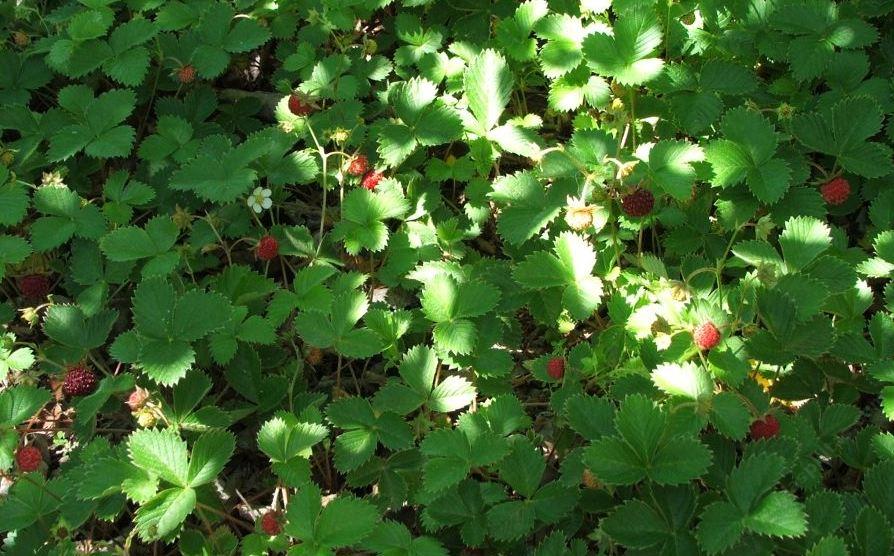
Guest Author Dan Songster penned this Plant of the Month article for March featuring Woodland Strawberry.
- What: Woodland Strawberry-Fragaria vesca
- Plant Type: Perennial ground cover
- Light: Sun to partial shade
- Soil: Adaptable–can tolerate clay soils
- Water: Occasional is best
Description
Our Woodland Strawberry (Fragaria vesca) is a vigorous, mat-forming California native groundcover, ideal for shady, woodland-style gardens. It features delicate white flowers normally followed by small, sweet, edible red berries. It spreads by long runners to create a lush, 3- to 6-inch high evergreen carpet. It is a member of the Rose family (Rosaceae).

Naturally occurring across the Northern Hemisphere, Woodland Strawberry is great for use in gardens of almost any size. Although it does best with some moisture, it grows well even in dry shade. If you would like a lovely light green ground cover that suits a shady woodland style landscape, fills in fast, takes a variety of soils and watering regimes, and if you like the idea of plucking tart but tasty little strawberries from your native landscape–the Woodland Strawberry may be just the thing!
Garden Uses
This native runner makes a fast and easy to care for evergreen mat of charming strawberry leaves with a clean green color. A great colonizer even in large gardens, it can cover a lightly shaded slope or beds with its stoloniferous runners and in smaller gardens, it can be part of a meadow effect.
Individually, the small blossoms are often lost in gardens but are quite attractive en mass during its spring bloom. Bees and other pollinators adore the flowers. Of course, the real treasure is the strawberries which are enjoyed both by wildlife and humans. These fruits are slightly smaller than our other California strawberry (Fragaria chiloensis) but are considered more tasty. The berries are great on granola, on a walnut salad, or just picked and eaten out of hand. Note: Although Woodland Strawberry does well in shady gardens, too much shade and you will have fewer strawberries.

As the name suggests, Woodland Strawberry looks at home when placed among other woodsy, partial shade plants like Douglas iris, giant chain fern, and meadow rue. It is an excellent plant for a small courtyards or along pathways, and even between stepping stones. It deals well with root competition and thin soils, and is well suited for growing under trees–even oaks and conifers. A tough little plant, it can accept light foot traffic and can be used as a lawn substitute. It can even work well in containers!
Care
Maintenance? Not too much to do. Woodland Strawberry is said to be deer resistant, and can live through periods without much rain (or irrigation) but looks best with at least a little summer water.
Older colonies that are losing vigor can sometimes be rejuvenated by a fairly ruthless combing with a steel garden rake (or going through with a string trimmer), a light feeding, and a thorough watering. This can be done around the first rains of the season.
As it crawls into nearby areas of the garden, if unwanted, the runners can simply be pulled up. They may then be replanted where you wish or given to a friend–propagation is easy since these plantlets root so easily. To propagate more plants, dig up and relocate new plants that have rooted from the runners. Do this in early spring just as new growth appears.
Special Note
Fragaria vesca ‘Montana de Oro’ is a cultivar that we have been growing at Golden West College Native Garden for the last 25 years and it does well. This cultivar was selected from a population in the Montana de Oro State Park region in San Luis Obispo County. It is said to have been chosen for improved vigor, heavy bloom, long bloom period (January – July), and tasty berries.

Leave a Reply