
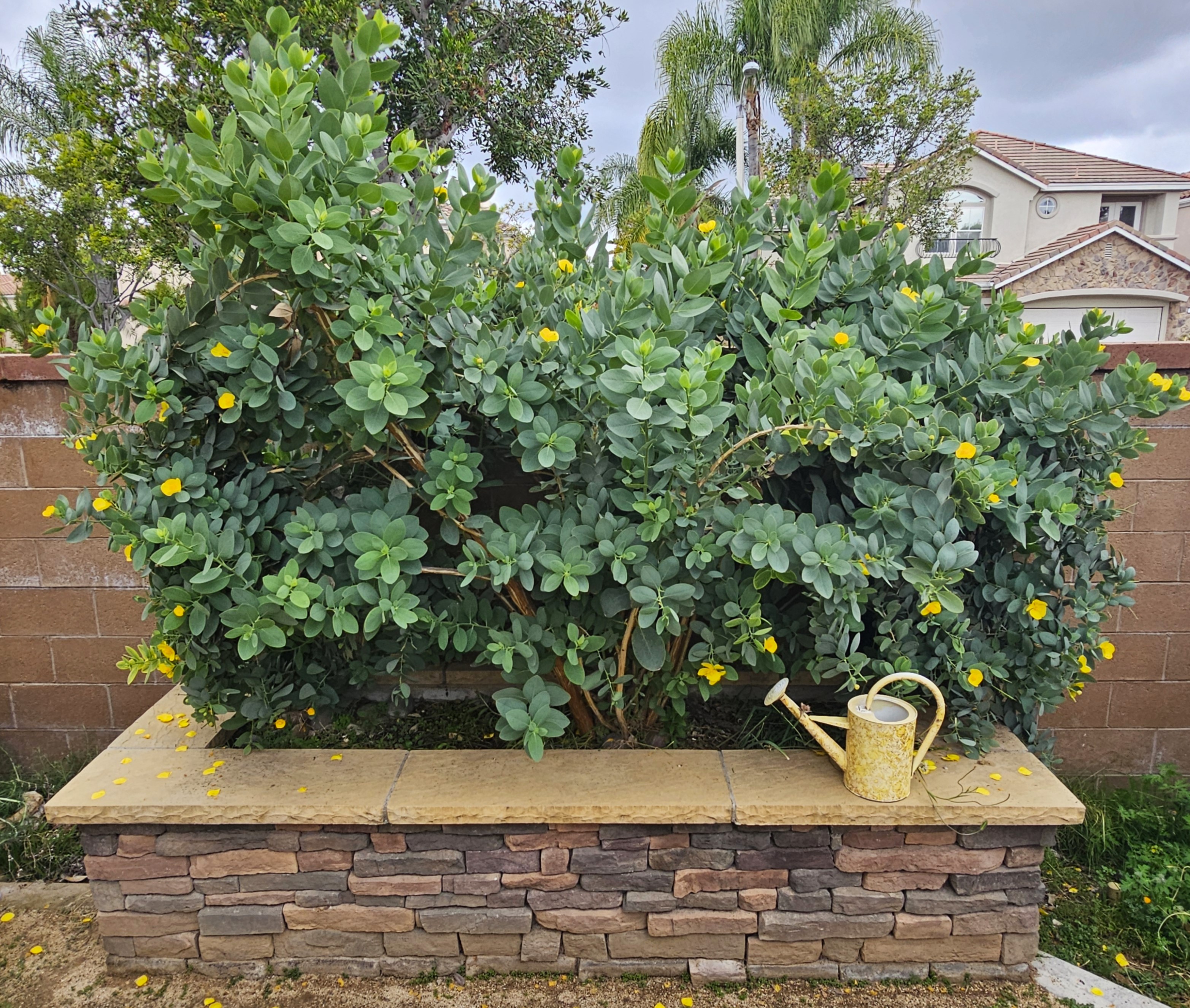
Guest author Dan Songster features the Island Bush Poppy as our Plant of the Month for May.
- What: Dendromecon harfordii, Island Bush Poppy
- Type: Evergreen Shrub
- Light: Full sun to partial shade
- Soil: Likes good draining soils but is adaptable
- Water: Drought tolerant
From the Channel Islands
The Island bush poppy, Dendromecon harfordii, is found growing on the Channel Islands off the coast of Southern California and is perhaps the most popular Channel Island endemic. When compared to its mainland relative Dendromecon rigida, it is considered more ornamental, easier for gardeners to grow, has a longer blooming season, and is the one plant that you are more likely to find for sale in native nurseries.

Beautiful Foliage and Flowers
A dense evergreen shrub with a pastel-like combination of beautiful bluish-green leaves and bright three-inch-wide buttery yellow flowers, Island bush poppy grows quickly to 5-8′ tall (sometimes continuing to 10 feet or more if very happy) and 6-10′ wide.
As is usual in the poppy family, Papaveraceae, the flowers are produced singly, not in clusters. They are abundant in late winter, spring, and early summer, but may appear more sporadically through much of the year. It’s not surprising when there are a fair number of flowers blooming even in late summer, in fact when situated near the coast, Island bush poppy can bloom almost year-round.

I have seen it planted as a loose-formed espalier on an east wall and as a foundation plant hiding the side of a stairway near a back patio, or as a hedge or screen that requires very little water. Normally, Island bush poppy is used as a large but stunning background plant. In smaller gardens it can anchor the garden visually as its main focal point.
Large enough to compete with its lovely but aggressive cousin, the Matilija Poppy, you can imagine what it looks like with any of our native blue-flowered California lilacs (Ceanothus sp.).

Pruning and Care
Regarding pruning, I like tipping the plant back lightly but if it gets too big it can be treated more harshly. If it gets too large, you can safely remove half or more of the plant around November or December. It re-sprouts generously and if those branches are tipped back again it forms a more dense and floriferous plant the next year.
A Few Words of Caution
If the bush poppy is an old, senescing plant, it is risky to prune it hard since it may not recover. If it is really in decline, coppicing the plant is like rolling the dice. You may win with a reemerging floriferous plant or lose by accelerating its demise.
While it really does best in coarse, well drained soils, Island bush poppy can and does take clay soils. Be aware that the life span of a bush poppy in clay soil can sometimes be shorter, often only lasting 6 to 10 years. This plant does not like summer water and if repeatedly given water during hot summers, it can fold in just a few years or less.
Keep this in mind when selecting companion plants. Choose companion plants like ceanothus, manzanita, and woolly blue curls, that also abhor excess water once established.

Be careful when planting, like many of the other true poppies, it can be difficult to establish due to an especially brittle root system that will not accept careless handling. If you don’t disturb the fragile root ball when planting and don’t overwater, it should be fine. Like many of our natives, fall to mid-winter is the best time of year to plant. Although with this plant, you can be successful even with spring plantings.
Where to Find Bush Poppy
Finding this lovely plant in nurseries can be hit and miss. Currently Tree of Life has some Dendromecon harfordii.
The late but great, Bert Wilson of Las Pilitas Nursery noted, “…it is rare in cultivation and hard to produce.” So if you see one, grab it when you can. Your garden will always look happier with this lovely plant on display.

Leave a Reply