
Native Gardener’s Corner-Member’s Tips, Tricks, and Techniques
This column is a regular newsletter feature compiled by guest author Dan Songster that offers OCCNPS chapter members and local experts a chance to share information on many things related to gardening with natives.
Our question for March/April:
When designing an area for privacy, what native plants would you choose for a screen or hedge?
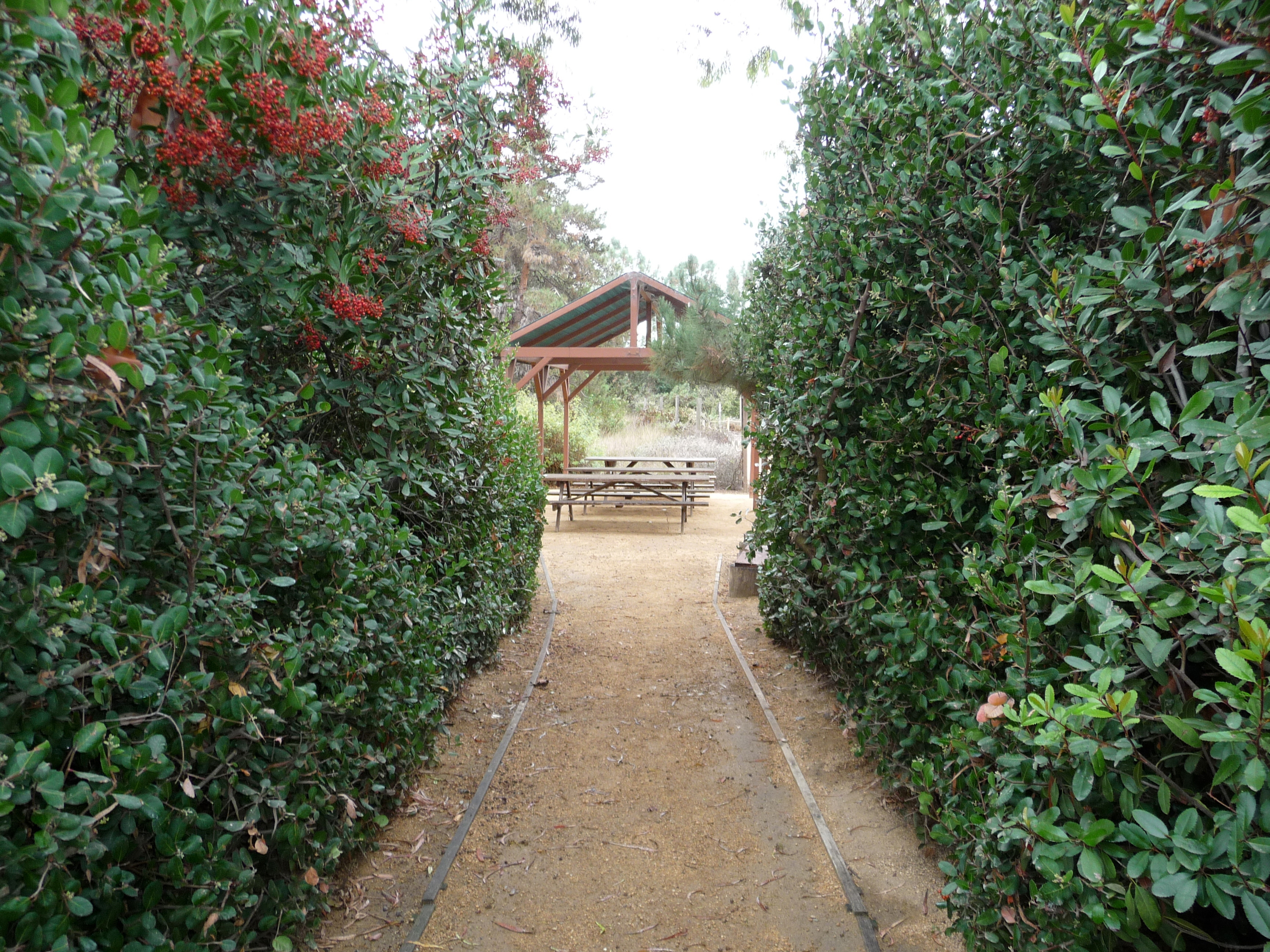
Brad Jenkins-“Lemonade Berry (Rhus integrifolia): Dark, full, evergreen. Easy to grow in a variety of environments. Very pruning tolerant. Shape as large bush, small tree (20+ feet), or large hedge. Very native to Orange County. Looks appropriate with plants from a variety of communities.

Also, the Island Tree Poppy, (Dendromecon harfordii): Has yellow flowers much of the year. The “green-gray-hint of blue” leaves are roundish and provide landscape variety. Can be shaped into a 6+ foot high hedge, just be especially mindful and forward thinking of this type of pruning. Once established, keep summer water to a minimum. With this dryer summer ground, I have put bulbs underneath such as native onion, blue dicks, and Calochortus. All this color combines for a nice focal point in the garden.”

Leon Baginski-“Rhus integrifolia (Lemonade Berry) is my number one. But Catalina Cherry can work and so can Ceanothus ‘Snow Flurry’.”
Amy Litton-“Lemonade Berry makes for a wonderful privacy screen. We’ve had this between our driveway and the neighbor’s yard and it’s a delight to see birds taking cover from both yards! It’s easy to prune away from the driveway, and the front section is lower so we can see cars and pedestrians. The bees love it, too!”

Greg Rubin-“Here’s a list of some of my “go-to” plants for hedge/screens: Toyon, Lemonade Berry, and Sugarbush, of course. I like various upright Ceanothus like ‘Frosty Blue’, ‘Ray Hartman’, ‘Snow Flurry’, ‘Mountain Haze’ and Ceanothus cyaneus with C. leucodermis. Put these different blues together and it looks like a Monet painting! Also, consider Mountain Mahogany (especially Cercocarpus betuloides var. blancheae), Catalina Cherry, Coffeeberry, Pacific Wax Myrtle (where it can get a little extra moisture away from the coast), and for Manzanitas there is ‘Dr. Hurd’, ‘Byrd Hill’, and ‘Austin Griffiths’.”

Sarah Jayne-“For screening in a huge backyard I would use Toyon and Lemonade Berry, with smaller shrubs filling in here and there. In my tiny yard it’s just the fence.”
Tina Cremer-“I would choose the Heteromeles arbutifolia (Toyon) because it flowers in the spring and provides beautiful red berries for the birds in winter. The tree is very hardy and doesn’t mind being heavily pruned to maintain its width.”

Bart O’Bien-“Hedges and screens are a perennial issue throughout California. Most require a fair amount of horizontal space in order to really block views and provide privacy. Some of the best of these larger plants include: Rhus ovata and R. integrifolia – with the latter taking to hard pruning and shaping, though ovata is (in my opinion) a much more beautiful shrub (love those tacoid leaves through the year and the bright red flower buds over the holiday months). Berberis nevinii is very effective thwarting humans (including yourself) because of their highly prickly leaves and rigid stiff branches. Wear durable gloves and use a sturdy rake if you intend to try to garden under/around them.”

Toyon is a next level down my list as it tends to open up more with age and can be afflicted with a variety of pests and diseases – but when it’s healthy and happy, there’s almost nothing better. The profusion of creamy-white flowers in June and excellent displays of holiday-red berries from November through January are more than enough to bump it up on many a gardener’s list. If left alone too long, toyon will, in most gardens, become a small tree – however, it has a basal burl, so it can be coppiced if necessary to start it’s upright growth all over again.
With a lot more work, one can grow some of the mid-sized manzanitas almost two-dimensionally – and while such sculpted plants won’t be terribly effective at blocking views, they can provide a psychological feeling of enclosure. Look for species or cultivars that produce strongly upright growth habits and that don’t have especially large main trunks. I have seen A. ‘Sentinel’ used effectively, and would think that A. bakeri ‘Louis Edmunds’ could be equally successful. Cercocarpus betuloides can be kept similarly “thin” and usually grows faster, but is rarely if ever dense enough to block incoming views.”
Ron Vanderhoff-“Two locally native plants come immediately to mind for larger spaces, Rhus integrifolia (Lemonade Berry) and Cercocarpus betuloides (Mountain Mahogany), for their tolerance of urban landscape environments. Both can tolerate clipping and modest summer irrigation especially the Rhus, and both have dense, branched growth that can be trained as perimeter or screening plants. Both are evergreen, drought tolerant, and reasonably carefree once established. The Rhus is naturally a bit broader than the Cercocarpus.”
Laura Camp-“I have Mock Orange (Philadephus lewisii) in my side yard. It is dormant in the winter, so maybe good for a tall hedge but not so great for a real screen. The best screen I know is either Lemonade Berry or Jojoba (Simmondsia chinensis). The Jojoba is such a pretty soft blue-green color and it can do well on a half day of sun to full sun and no water. I am also using Mountain Mahogany for a screen and it can be a good hedge as well.”

Dan Songster-“Some of my favorites that do a fair screening job and still provide excellent interest are Hollyleaf Cherry (Prunus Ilicifolia) and Ceanothus ‘Ray Hartman’. The Hollyleaf Cherry provides quick but dense growth, shiny leaves, and can take shearing as needed. Its normal spring blooms are lovey. Normally the pruning needed to make it a hedge/screen means fewer of the flowers are there to become those big cherries the birds like, in summer. The Ceanothus ‘Ray Hartman’ has more of a lacy effect but is so lovely when it is in bloom.

Note: As Laura Camp mentioned, Simmondsia chinensis (Jojoba) can be very nice as well. Also, Bart reminded me how good Nevin’s Barberry (Berberis nevinii) can be.”
Our question for the coming May/June 2025 newsletter is:
“Do you grow any native flowers with an eye for creating indoor bouquets? If so, which ones and why?”
Email your responses to Dan Songster at songster@cox.net. Please attempt to keep replies brief so we can include most of the responses.


Leave a Reply to E. WallaceCancel reply