
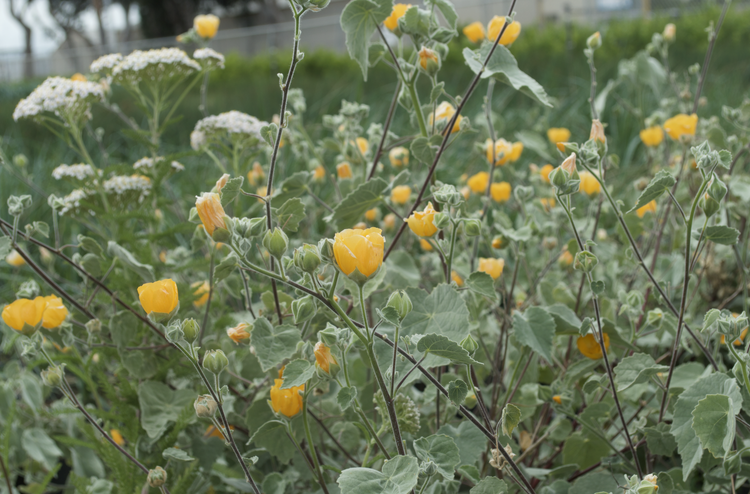
This article, submitted by Dan Songster, features Abutilon palmeri, a lovely native plant with abundant golden blossoms in the garden.
- What: Abutilon palmeri–Indian Mallow
- Type: Semi evergreen to evergreen subshrub
- Light: Full sun but can take a touch of afternoon shade inland
- Soil: Well-drained but adaptable to clay soils
- Water: Drought tolerant
- Common Habitat: Dry rocky slopes, canyons, and washes in desert scrub communities in the southwest

Indian Mallow is a dense, rounded fast growing sometimes sprawling evergreen shrub that reaches 4 to 5 feet tall and as wide. Almost as lovely as its floral display are its silvery, velvety-soft, heart-shaped leaves with dentate margins. It has one inch wide, poppy-like flowers which are luminous, gold to apricot in fairly dense clusters held on wiry stems.

Blooming nearly year-round, (with peak bloom in spring and summer) these flowers are especially attractive to native solitary bees. After the flower petals have dropped, the sepals remain with the developing fruit that can be used in dry flower arrangements. Seeds that fall while birds are feeding easily sprout in your garden but don’t become weedy.

Plant in well-draining soil with only occasional to very little irrigation, in full sun along the coast and with light shade inland.
Bert Wilson of Las Pilitas Nursery says ”How such a soft plant can live on rocky, dry slopes is befuddling. In the garden it can be equally astounding. Flowers seem to continually reappear for most of the spring making dazzling shows…”
In dry years, Abutilon palmeri can be drought deciduous and benefits from occasional watering, but be careful not to overwater, particularly in heavy soils. This is great plant for the dry garden and particularly nice near paths or seating areas where the foliage and flowers can be appreciated.

The silvery foliage and golden flowers stand out among boulders and gravel too. It can also be placed alongside plants like a small-to-midsized ceanothus where even if the bloom times do not overlap, the lovely texture difference between the silvery green fuzzy leaves of the mallow contrast with the shiny green leaves of the ceanothus.
Care: This is a frost sensitive plant which can survive short periods of cold down to around 25° F. If tips are damaged by cold temperature, they can be pruned off in early spring. In Southern California, where frosts are not common, pinching and tipping plants back in spring and early summer encourages denser growth and a longer bloom period. Some folks feel it is best to prune back regularly after flowering.

Abutilon palmeri may require protection (caging) from rabbits and other herbivores when young. Other pests can include aphids, whitefly, and scale. Use horticultural soap to wash pests off the shrub. But be careful because some people have found that the more water you provide, the greater the chance for infestation on the resulting tender and appetizing new growth.
Additional Information: Indian Mallow is native to the low Sonoran Desert in Southern California, Arizona, and northwestern Mexico and in the San Jacinto Mountain area where it can be found on dry rocky east facing mountain slopes and creosote bush scrublands from 1,800 to 2,400 feet.
The name honors the British born self-taught botanist and naturalist Edward Palmer (1829-1911) who came to the U.S. as a teenager and worked for the Department of Agriculture, the Smithsonian Institute, and the Army Medical Museum–eventually leading an expedition to explore the flora and fauna of California and Death Valley. Other common names include Palmer’s Abutilon, Superstition Mallow, and Palmer’s Indian Mallow.
Bloggers Note: Indian Mallow is an elegant plant to install as the focal point of your garden. You can use this plant to fill in quickly while you wait for slower-growing plants like manzanitas to catch up.
#californianativeplantsociety #gardening #nativeplants #bees #butterflies

Leave a Reply