
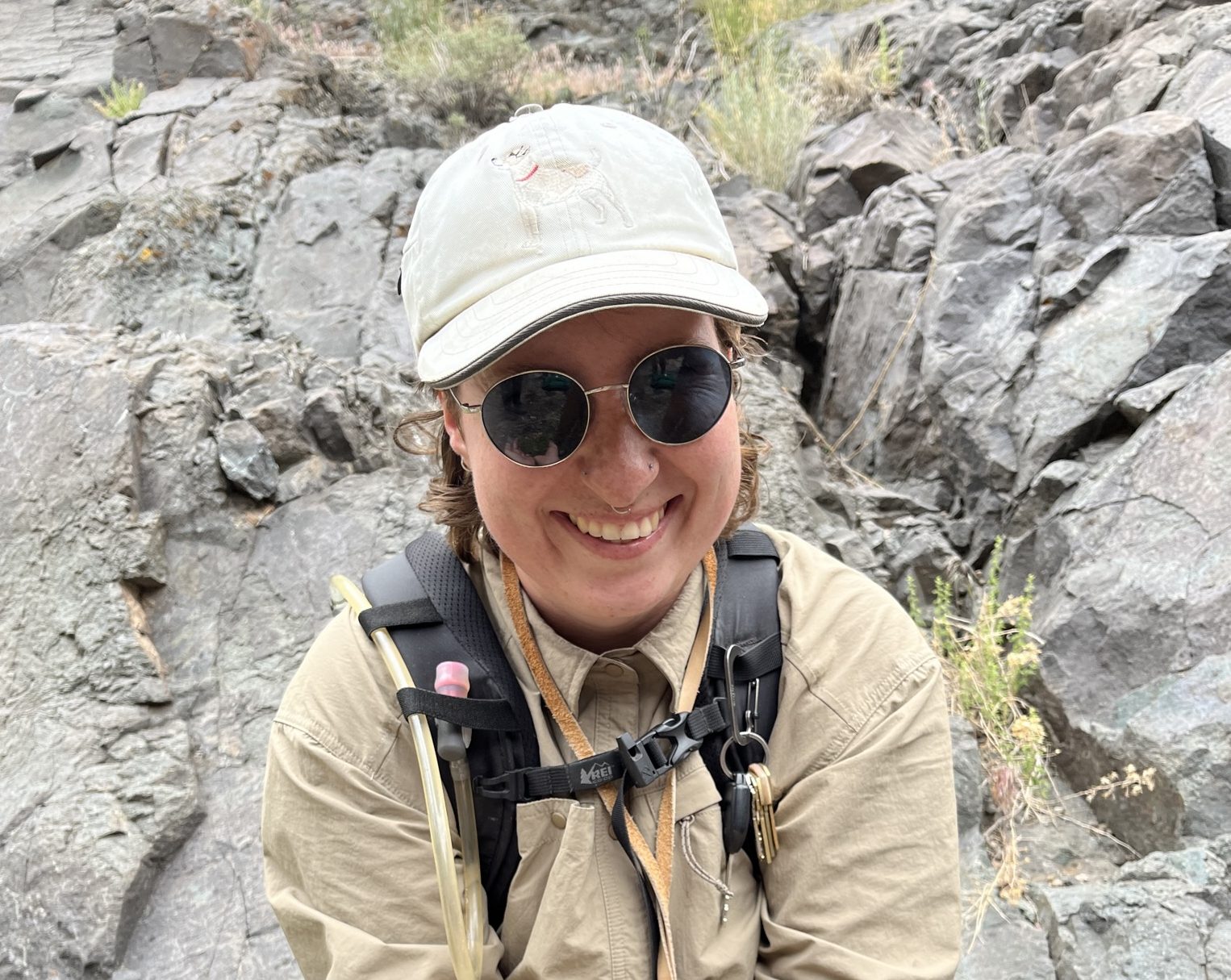
Compiled by guest author Thea Gavin, this article features Mel Letterman, board member of the Orange County Chapter of the California Native Plant Society (OCCNPS).
A chapter member for three years, Mel Letterman (they/he) is another recent addition to the OCCNPS board. With interest and expertise in plant science, conservation, and education, Mel is already making an impact with his work on the following chapter teams: Field Trips, Social Media, Coloring Book, OC Parks Vascular Plant Checklists, Monthly Programs, and Plant Science.
In addition, Mel serves as one of the chapter’s State CNPS Council representatives, traveling throughout the state to quarterly meetings where all of the chapters participate in important state-level CNPS business.

A busy schedule of both paid and volunteer positions supporting California native plants feeds Mel’s enthusiasm about increasing CNPS’s outreach to the diverse OC community.
Here are some of Mel’s insights into his past, present, and future with California native plants.
Past
How did you get interested in native plants?
I was born and raised in Costa Mesa, and I grew up in a family with three brothers. Our limited budget meant that many of our family vacations were spent outdoors in the San Bernardino Mountains and at local beaches.
My first memory of native plants is probably from a visit to the Environmental Nature Center in Newport Beach. That was where I learned about Poison Oak (Toxicodendron diversilobum), and I still remember being amazed that this plant grew so near my house.
Another early memory was Astro Camp in fifth grade in the San Jacinto Mountains; after shooting off rockets, I would wanter around camp and pick up acorn caps, and again I remember being amazed that I was near real oak trees in Southern California.

I did not really appreciate native plants, though, until I started working at Fairview Park in Costa Mesa doing habitat restoration. At first, I was just there for fun and had no clue about any of the native plants I was putting into the ground. As I continued to work there, I learned that Fairview Park contains incredible coastal vernal pools, which are very uncommon due to the urbanization of Southern California.
Once, during those early days of working at Fairview Park, I told biologist Barry Nerhus that his talk about vernal pools–which I had already heard several times–was boring and repetitive. That moment lives in my head forever because at that point I still had no clue how special and important those vernal pool complexes were and still are today. Another memory from my time working at Fairview Park (around 2016) was when Fred Roberts lead an OCCNPS chapter field trip to look at those rare vernal pools. Again, I thought, “Boring!” Then, after Fred’s walk, I was baffled that people were lined up to buy the native plant books he was selling out of his car.
Now? I own most of Fred’s books, I know many of our local plant by name (botanical and common), and I am so happy to be a part of this native plant community.
What kind of education and training has helped you learn about native plants?
My training has been a combination of formal and informal.
I went to Orange Coast College (OCC) for a few years and didn’t start taking biology/ecology courses until my third year there. I was initially going to transfer to UC Santa Cruz, but decided to stay at OCC for a fourth year to take all the various ecology courses offered. These courses included desert, island, intertidal, and Mediterranean biome ecology; I also took Bob Allen’s botany course.
Unfortunately, the COVID pandemic began in the middle of my last semester while taking Bob’s class, but he was a huge motivation to learn more about local plants. His book (co-authored by Fred Roberts), Wildflowers of Orange County and the Santa Ana Mountains became my go-to.
Taking Bob’s course led to me joining OCCNPS’ Checklist of Casper’s Wilderness Park field trip in the summer of 2020. I also spent a lot of time outside and learned the names of local plants with the Wildflowers of Orange County book.
In fall 2020, I transferred to CSUF for a B.S. in Plant Biology. While there, I worked at the Biology Greenhouse for two years helping take care of the plant collection, conducted student research through SCERP (Southern California Ecosystems Research Program), and assisted as herbarium manager at the MacFadden Herbarium. I have not yet earned my undergraduate degree because I hit a roadblock with some mandatory courses in organic chemistry and physics, but I hope to finish in the spring 2025.
Over the last few years, I have worked a variety of plant-related jobs. Before the pandemic, I did restoration and administrative work at Fairview Park for the City of Costa Mesa. From there I spent time at REI and at Tree of Life Nursery, and I now work at the Irvine Ranch Conservancy (IRC)’s Native Seed Farm.

At the Native Seed Farm, I process seed in bulk to be stored for habitat restoration, survey and collect seeds in open space areas within Orange and Riverside counties, assist with various research and invasive monitoring (spadefoot monitoring, invasive and native vegetation monitoring, GSOB monitoring), propagate and care for native plants in a small nursery, and tend to the twelve acres that make up the farm.
My future goal is to work as a field botanist or herbarium curator somewhere in the deserts of the southwest. In addition, I would love to pursue becoming a community college professor.
Present
After what sounds like a rocky start at Fairview Park, how would you describe your attitude toward native plants now?
At this point, my entire life is dedicated to native plants. I talk about them as much as I can because many people don’t understand the value of native plants, thinking natives are associated with fire and look “weedy.” I want people to know how beautiful and beneficial native plants are, from the most showy flowers to the most “boring-looking” shrubs. One of my biggest drivers for sharing about native plants are the benefits–the interdependence–that pollinators, insects, critters, and humans have with them.
What native-plant-related projects are you working on right now?
I have been volunteering at the Fay A. MacFadden Herbarium at CSU Fullerton as the herbarium manager; my work there involves mounting, imaging, processing, and curating the collection. The MacFadden Herbarium seems to have been a bit neglected over the years, and I want to uplift it and get more of its collections into the Consortium of California Herbaria (CCH2).

Another personal project I am working on is documenting the plants at Brea Dam Park in Fullerton. This park, primarily used as a flood control area, has some trails for walking and biking but is under-documented in terms of herbarium and iNaturalist observations. For this reason, I have been slowly collecting and documenting all the plants throughout the area.
Another documentation project I am working on with the OCCNPS chapter is assisting a great group of seasoned botanists to collect herbarium vouchers at Whiting Ranch Wilderness Park for a checklist produced by the UCI Herbarium.
There is also a “plant-adjacent” project I have been volunteering for: doing bumble bee surveys for Xerces’ California Bumble Bee Atlas. By using my native plant knowledge, I can better observe and document bumble bees within Southern California’s open spaces.
What kind of native-plant-related legacy would you like to leave?
I would like to be known for helping educate people about native plants in a kind and non-abrasive way. While going on native plant walks (CNPS and non-CNPS), I have run into some very amazing people, but also some not so amazing people. I am not in the native plant field to put others down for their level of knowledge, experience, or any other status. If someone has a question or wants to discuss plants or ecology, I will meet them with the amount of kindness and respect that I would want. Everyone deserves to have open access to knowledge about native plants, and I want to be a part of that movement.
Additionally, I want to be known for my work with local herbaria. Sadly, there has been a lack of appreciation and funding for herbaria all over the world. The most devastating recent news was Duke University’s closing of their herbarium. If a major institution like Duke shut down their herbarium, what is stopping other smaller universities from doing the same thing? Supporting local herbaria is essential for their existence.
Volunteering to mount specimens, collecting plants in the field, and digitizing records are some of the best ways to help. We have two herbaria locally to the county, UCI and CSUF, but there are many others close by at CSULB, SDSU, and UCR. One of my botany dreams is to become an herbarium curator and conduct my own major flora project somewhere in an under-documented part of the desert in Nevada or California.

What OCCNPS activities would you encourage others to try?
Field trips! You get to go outside, look at plants and critters, and hang out with a bunch of plant people who can identify any plant/fungi/rock/insect.
I’m also a huge fan of the monthly program meetings. Dan Songster was the previous program meeting lead and he brought in fantastic speakers. I hope to bring in as interesting and engaging talks as he did.
Lately, I have been getting more interested in emergent invasive plant identification and removal, along with rare plant conservation–these are activities of the chapter’s conservation and plant science committees. I believe these two go hand in hand because botany is just a real life version of iSpy, with invasive and rare plants are the objects you want to find (at least that is how my mind works).
It feels really rewarding to find new documented populations of rare and invasive plants because you can protect the area through removal of invasive plants and continue monitoring that area over years to maintain a healthy native ecosystem.
Do you have any natives planted in your yard?
I live in an apartment and do not have my own yard, but I have been experimenting with container gardening. I am lucky to have two balconies at my place, so that means I get a lot of space for my plants. Nearly all plants I have are locally native or at least native to California. I really try to put an emphasis on supporting local pollinators by using plants native to coastal Orange County.
One of my favorite plants is an Elephant Tree (Bursera microphylla) given to me by Ed Read, my former boss at CSUF Biology Greenhouse. This plant is doing very well and I hope to grow it as large and beautiful as the ones there.

One of my next projects is getting a large planter box, so I can put some milkweed and other hyper-local plants in to help promote native pollinators in my area.
What is one thing you have learned about native plants that you didn’t know when you started this journey?
One of my favorite things to learn about is pollinator interactions between native plants and insects, birds, and other animals. It’s been really interesting and sad to notice how the generic, non-native garden plants that most people put into their gardens sustain no insect activity. Without native plants, insects do not stand a chance at survival with increased climate change and urbanization.
Another thing I have been excited to learn about is that many of the Latin names given to plants usually have a meaning. For example, black sage (Salvia mellifera): mellifera means “to have bees” and I think that is such a great description as it is a major host plant for our native bumble bees.

Future
What are your goals for our chapter and/or the California native plant community at large?
I want to expand the native plant community to include marginalized communities. As a queer and transgender person, I do not see others like myself in CNPS.
Within the last year, I have been approached by so many young queer people to thank me for my presence within the native plant scene because they see someone like them doing something they also love. There are many groups of people that are under-represented within our chapter and CNPS as a whole: folks that are BIPOC (black, indigenous, and other people of color), LQBTQI+ (lesbian, queer, bisexual, transgender, queer, intersex+), have a disability, and/or are younger and not often seen within this organization.
My goal is to promote and uplift the voices that need to be heard within the native plant world–through education, outreach, and all other aspects of plants and community.
Another goal is helping complete the checklists of all the Orange County Wilderness Parks. Caspers Wilderness Park has been completed and Whiting Ranch Wilderness Park is underway, but other parks like Aliso & Wood Canyon, Laguna Canyon, and Thomas F. Riley Wilderness Parks do not have checklists yet.
Documentation is important in the technological time we are in. Anyone can take pictures and upload them onto the internet and contribute to community science.

Do you have any native plant “heroes” or mentors who shaped your interest in native plants?
I have so many heroes…
At OCC, Kelli Elliott and Bob Allen were two professors that showed me that botany and ecology was something that I could pursue– they were both so engaging and excited about ecology and they inspired me to be where I am today.
Many local botanists in Orange County–like Ron Vanderhoff, Fred Roberts, Rebecca Crowe, and Sandy Leatherman–have been great inspirations because they have shown me that there is much to discover and document even in an area that has been heavily urbanized.
My principal investigator and his partner, Josh Der and Kristal Watrous, have been mentors to me within the last year; Josh has helped me further my love for herbarium work and understanding plant taxonomy, and Kristal has fostered my love for insects, more specifically bumble bees.
Botanist Naomi Fraga has also inspired me– I have worked with her a few times this year while volunteering for the California Botanic Garden, and I hope one day to be able to have as much plant knowledge crammed into my brain as she does.
Lastly, I have countless friends that I look up to immensely for their knowledge and enthusiasm in botany. To name a few but not all are Megan Peukert-Curran, Sunny Saroa, Ryan Brooks, Daphne Christle, Emyle Rogers, Eric Koberle, and Matt Smith.

Do you have any native plant wisdom/encouragement you’d like to share?
Never stop being curious! There is always something to learn and places to explore. Building community will help you deepen your knowledge. Reach out to other folks that are also interested in what you want to learn about. You would be surprised at the enthusiasm others have for helping and teaching others.
If you are trying to buckle down and get really serious about plant taxonomy, I recommend learning plant families within your local area. Knowing a plant’s family will unlock understanding and make learning botanical names much easier.


Leave a Reply to NateCancel reply