
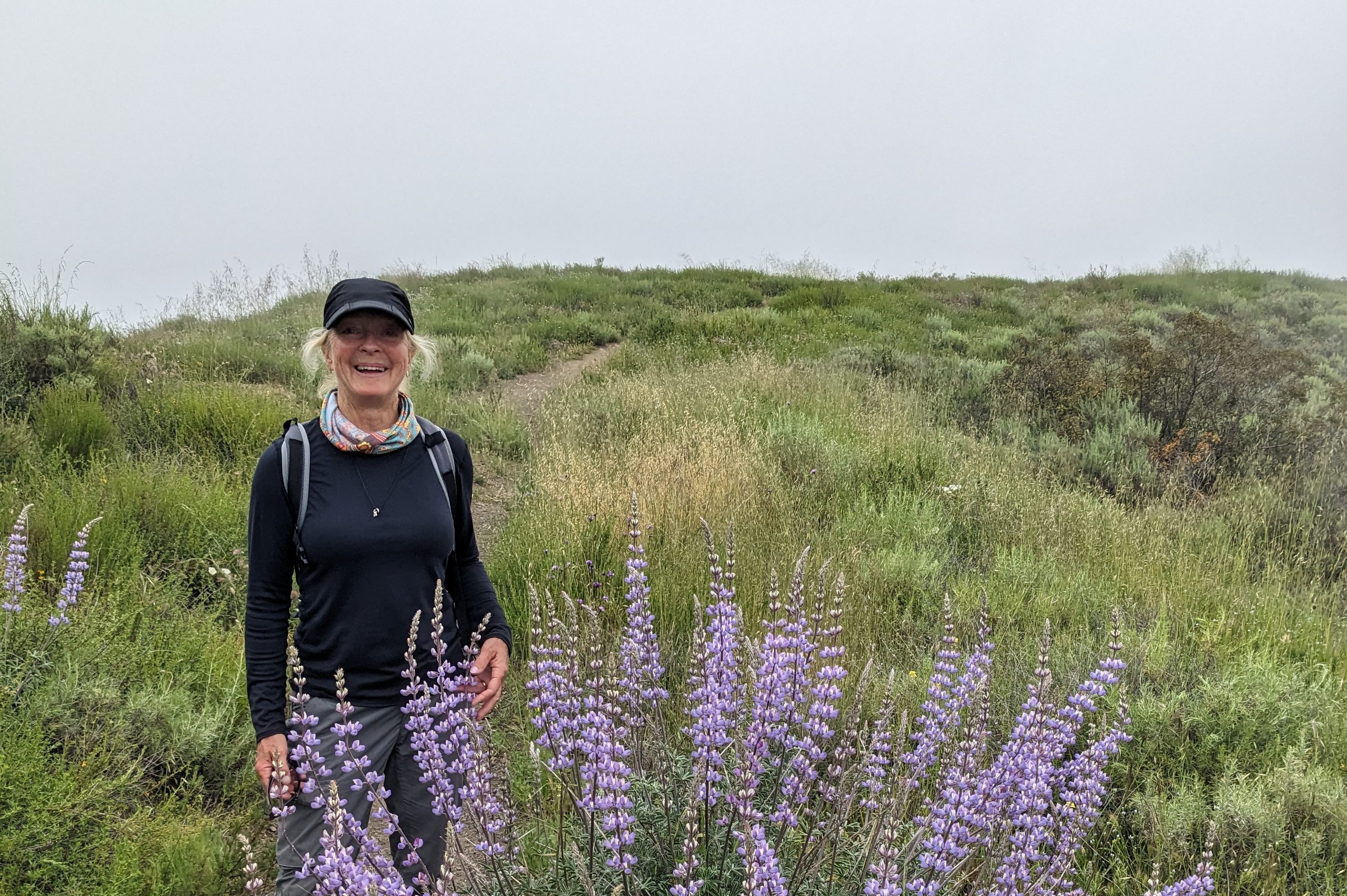
Board Member Lesley Bindloss is featured this month in an article compiled by Thea Gavin.
Lesley Bindloss is a fairly new CNPS-OC board member with an “unsung hero” role on the board: Recording Secretary. This is the person who must take accurate notes during board meetings to make sure all discussions and decisions have proper documentation.

As vital as those duties are, Lesley is even more passionate about working directly with native plants—in both cultivated and wild settings—and educating others about their value.
How did this transplant from England who moved to California in 1984—knowing nothing about native plants—end up learning about and loving Orange County’s local plant communities and now, in retirement, working tirelessly on their behalf?
It’s been a life-long journey.
“I’ve always loved being outdoors,” Lesley said. “Growing up in England, I remember playing in the woods near our house, climbing huge old oak trees and collecting horse chestnuts for games of ‘conkers’ with my friends.”
When she went to university in Southampton, UK, to study English and Italian, Lesley enjoyed going on WOOF weekends (Working Weekends on Organic Farms). “I became aware of how we interact with and impact the natural world.”
After she moved to California in 1984, native plants were still not on her radar, although she did continue her love of being outdoors by hiking with a group from the city of Irvine. It was during these hikes that Lesley fell under the spell: “Knowledgeable people would point out various plants and trees, and my acquaintance with our flora and fauna began.”
In 2007, after her children were teenagers and she had more time, Lesley took a Naturalist Training class, a requirement to became a docent with the Irvine Ranch Conservancy (IRC). “That class solidified a love for native plants that has grown over time and has led to my commitment to share their importance.”
Fast-forward to 2020; the (pandemic) time seemed right to retire from her job teaching ESL, and Brad Jenkins (CNPS-OC president at the time), asked Lesley if she would like to use her new free time to help with a proposed native plant landscape project in Trabuco Canyon at Vera’s Sanctuary (the only licensed residential drug treatment site in Orange County dedicated to victims of human trafficking).
Lesley remembers that life-changing invitation in May 2020: “I jumped at the chance to be outside and contribute to something productive. Under the leadership of Elizabeth Wallace, we have converted an area of compact, barren dirt into a thriving butterfly garden bursting with color and life. The transformation has been stunning and inspiring.”
Since then Lesley and a small but mighty group of volunteers have installed, and now maintain, the soul-soothing native plant landscape at Vera’s Sanctuary.

Inspired by the success of planting natives there, Lesley turned her attention to converting her own home landscape. “I am enthusiastically introducing native plants to my small garden one by one. I have a thriving penstemon, hummingbird sage, and golden rod; I have a buckwheat, white sage, hillside gooseberry and a recently planted ceonothus. My plan is to convert my whole front yard to native plants over time.”
With all this experience comes hard-won knowledge, which Lesley is happy to share: “I made the novice mistake of wanting an instantly appealing garden and planted my natives too close together.” She also advises patience while waiting for newly planted natives to grow: “the first year they ‘sleep,’ the second year they ‘creep,’ and the third year they ‘leap.’”
Now Lesley is leveraging her native plant landscape knowledge to advise on larger projects: “I recently joined the Landscape Committee of my HOA. We are working on replacing turf with native plants and reducing the amount of chemical weed control used in the neighborhood. My experience in CNPS-OC is helping me to contribute in a positive way.”
Not only does Lesley enjoy working with natives in a landscape setting, she is also a regular out in the field: “I spend time each week in the wildlands with the Invasive Weed Team. Under the leadership of Joan Miller, we work to eradicate tree tobacco in O’Neill park, fennel and artichoke thistle in Laguna, and Sahara mustard in Caspers. No roots are too deep for this indefatigable team! It is productive and highly satisfying work. (Come and join us!) Over the years I’ve become passionate about protecting our native plants by removing the invasive plants that encroach on and degrade their habitat.”


As if that isn’t enough, Lesley is also passionate about CNPS-OC’s outreach events: “I like participating in events that educate the public about native plants. Adventure Day at Casper’s Park, the Sage In Every Garden giveaway, and the H2O for HOA events have been excellent ways to promote California native plants and our organization. Adventure Day was especially important in its appeal to children, who will be the future of our organization and our community.”
Looking forward to next year, Lesley hopes for an even larger Adventure Day turnout; she and Rebecca Crowe (another CNPS-OC board member) are developing a “repeatable presentation” to take to local children “to educate and inspire them to love native plants.”
When asked about her own sources of native plant inspiration, Lesley is quick to mention fellow CNPS-OC board members Elizabeth Wallace and Brad Jenkins: “They have generously shared their knowledge with me on a weekly basis as we work on projects (such as Vera’s Sanctuary) together. Also, Bob Sill has trained me to recognize native plants on hikes on our local trails. And every time I attend a gathering of native plant people, I am grateful to learn a huge amount.”

Lesley herself is an inspiring example of a transplant from far away who has grown to know and love California native plants, and who is eager to share that knowledge and love.
One of her goals as a board member is to help further CNPS-OC’s name recognition within the community so that this chapter becomes Orange County’s “go-to organization for anyone who’s interested in native plants. The more visible our chapter, the more people will realize how valuable and attractive native plants are. Education of the public, HOAs, and local cities is key.”
“Native plants are crucial to the health of birds, insects, and wildlife. When I learned that the fuzz from sycamore leaves is used by hummingbirds to line their nests, I was in awe. This amazing connection needs to be protected. Plus, native plants are beautiful! I hiked the Bell View trail last spring and counted 44 different wildflowers.”
Appreciation, conservation, education (not to mention taking board meeting minutes) . . . Lesley’s native plant journey continues.
Leave a Reply