
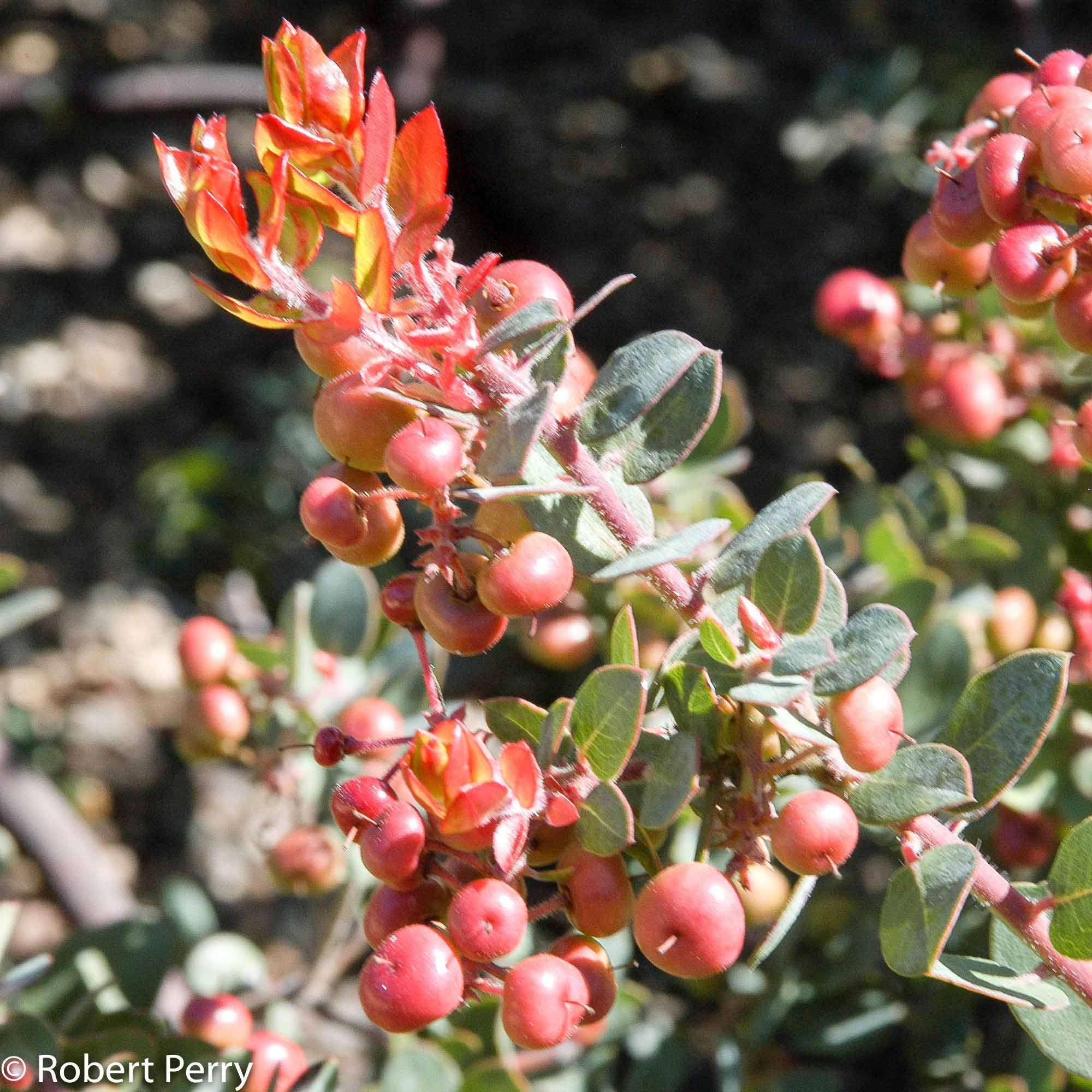
Guest author Dan Songster features ‘John Dourley’ Manzanita as the December Plant of the Month for the Orange County Chapter of the California Native plant Society (OCCNPS).
- What: Arctostaphylos ‘John Dourley’
- Common Name: ‘John Dourley’ Manzanita
- Plant Family: Ericaceae
- Type: Low Shrub or more likely a sprawling groundcover
- Light: Sun but can take a touch of shade
- Soil: Likes fair to good draining soils but can do well in clay.
- Water: Infrequent (Some dispute.)
Introductory Note: With the closing of Tree of Life Nursery, we thought it would be nice to recognize our friends there with one of their finest plant introductions.

Tree of Life Nursery wrote:
“Among all the plants TOLN has introduced over the years, this is the one we are most proud of. The plant has been in production for 30 years and is recognized in the trade as one of the sturdiest and most beautiful manzanita cultivars.”
The Basics
Arctostaphylos ‘John Dourley’ Manzanita is an attractive low growing shrub with a mounding habit, growing 2-3 feet tall by up to 6 (perhaps to 8) feet wide. There seems to be discrepancies on the size description for this plant, perhaps due to climatic or cultural conditions, as Las Pilitas Nursery notes it growing much smaller in their hotter and drier conditions.

New growth in spring has foliage that is an attractive orange-red color (like one of its likely parents, A. pajaroensis) – the leaves maturing to a waxy olive-green. The growth is somewhat open for a mounding manzanita but not sparse. Clusters of drooping, urn-shaped light pink flowers are abundant over a long winter blooming season, followed by berries that are purple-red.

‘John Dourley’ is a dependable tall ground cover selection with year-round interest.
Garden Uses
This versatile Manzanita makes a great understory for mature trees, or a foundation plant for large planters, parkways, banks, hillsides, and can be shown off in containers. Since it can be kept fairly compact, it is well-suited for smaller gardens. Like most Manzanitas, ‘John Dourley’ provides nectar for hummingbirds, berries for songbirds, and wonderful habitat for other native critters.

It is a great choice for use in the foreground in a planting of larger shrubs with similar requirements. It should also be noted that Orchid Black, the well-known plantswoman of the San Gabriel Chapter of CNPS, included this plant in her top ten list of ground covers.
Water
Although ‘John Dourley’ thrives in sun, it is at heart a coastal plant and will appreciate some protection from the afternoon sun especially inland where temperatures tend to be hotter.

There seems to be disagreement on how much water this plant requires or prefers. San Marcos Growers states, “Plant in full sun to light shade and irrigate occasionally to not at all.” Other respected sources, including Las Pilitas Nursery say, “‘John Dourley‘ manzanita seems to need more water than most other manzanita’s so situate accordingly.”
The reality is that where you garden and the type of soil in your garden has a big impact on watering of most natives and perhaps this particular one more than most.
Rogers Gardens summarizes my experience with this plant, saying “It is very adaptable to both dry and moist growing conditions, but will not tolerate any standing water.”
Good practice is to water deeply and infrequently during the cooler months. Allow the soil to dry out between any watering in summer months. Like most Manzanita species, it is susceptible to root rot which seems especially prevalent if overwatered during the hot summer months.
Pruning
If conditions are favorable and it is given the space it needs to reach maturity, it will only need occasional thinning to remove any branches that might have died, crossing branches, or any branches that are too long. Although easier said than done, it is a good idea as it matures to move other plants away if it is getting crowded.

I find that certain robust annuals like California Poppy, Elegant clarkia, and some of the larger Phacelia’s, can crowd and shade this low plant. Their moist leaves in winter and spring can cause fungal dieback of this Manzanita’s branches. Give it room to breathe.
Historical Background
Arctostaphylos ‘John Dourley’ is a volunteer seedling that was found by John Dourley, the former Superintendent of Horticulture at Rancho Santa Ana Botanic Garden (now California Botanic Garden) in an area having hybrid manzanitas at the botanic garden. This cultivar is of unknown parentage, though some speculate it to be a hybrid between Arctostaphylos pajaroensis and A. bakeri. This selection was named for the late John Dourley by Mike Evans and Jeff Bohn of Tree of Life Nursery. Both partners were very grateful for the friendship and mentoring of this Scottish plantsman, whose kindness and humor were evident to all who met him.

Do you have experience with ‘John Dourley’ Manzanitas in your garden? Write us back and tell us what you think.

Leave a Reply