
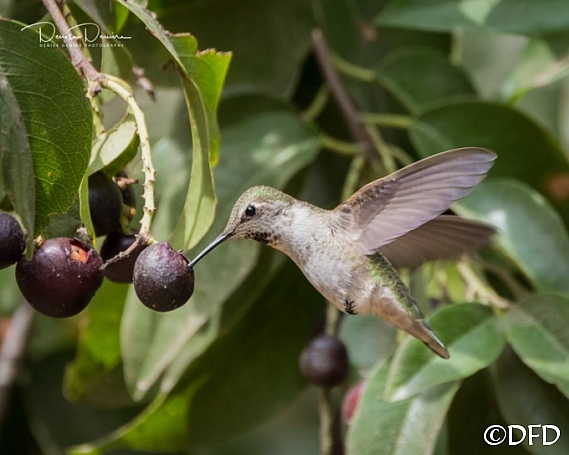
Guest author Dan Songster penned the Orange County Chapter of the California Native Plant Society’s (OCCNPS) October Plant of the Month featuring Hollyleaf Cherry.
- What: Hollyleaf Cherry, Holly-leaved Cherry, Islay (Prunus illicifolia)
- Family: Rose
- Type: Evergreen shrub
- Light: Prefers sun
- Soil: Adaptable
- Water: Very drought tolerant once established
- Common Habitat: Chaparral, canyons, southern oak woodland, moist and/or north-facing parts of dry slopes
Hollyleaf Cherry is a lovely plant all year long, but it comes into its own during the hot and dry months of fall in Southern California–a time of parched and often-brown hillsides. There are few plants that seem to thrive during the heat and drought like the Hollyleaf Cherry. It stands out during that stressful season with beautiful, almost lush, rich green leaves, and dark red fruit for the hungry birds. It is tolerant of heat, drought, and wind.

The Basics
Native to the California coast ranges from Mexico north to above San Francisco Bay, Hollyleaf Cherry is the only native species of Prunus in Orange County. It can be a large, evergreen shrub that may average 15 feet tall and wide, but its size can vary greatly depending on conditions. In dry, rocky or shallow soils, it will be bush-like from five to 15 feet, while in richer soils with more moisture it can attain large shrub or small tree size (some have reported up to 30-40 ft.). You can expect a specimen shrub or tree to grow to between ten and 15 feet tall. Yes, it can get larger, but I wouldn’t count on it.
As implied by the common name, the leaves on this plant resemble those of holly because they are wavy and serrated with spiny edges. These leaves are a bit shiny, one-to two-inches long and oval with a faint scent of amaretto almond liquor when crushed. A profusion of white flowers appear on terminal stems in spring from March through May drawing bees, butterflies, and other pollinating insects. Dark red to almost black fruit which songbirds love, is set in late summer and fall.

Garden Uses
An attractive and adaptable garden addition, this is a great plant for use as a tall dense screen planting and is an excellent native alternative for non-native hedges like the invasive Privet (ligustrum sp.).
Donald Peattie in his book A Natural History of Western Trees, states: “…as a hedge plant, Islay is ideal; it requires only a little pruning, rather than the typical hedge clipping, to make a lovely formal wall of shining green.”

Hollyleaf Cherry is also an excellent habitat plant, offering food and cover for wildlife. In spring there is much activity around the blossoms as bees work to get their nectar. Birds enjoy the small reddish-purple cherries and the shelter of its branches. The foliage is the larval food of the pale swallowtail butterfly, as well as the California Hairstreak, and Lorquin’s admiral.
Besides its ornamental features and habitat value, it can fill many functions in our home landscapes, serving as a foundation plant against a larger wall, a nice native alternative for boxed hedges in formal landscaping, and with its deep root system it is exceptionally well suited for erosion control on slopes.
Care
Plant in full sun to very light shade. As mentioned, this adaptable foothill native can be clipped into a formal hedge, pruned to be treelike, or left to its own natural gumdrop-shaped habit. Since Hollyleaf Cherry is known to re-sprout from its base after fire, it is likely to respond well to coppicing–the severest of all pruning techniques.

This tough native plant is a bit slow to establish the first year but then grows fairly fast, particularly if given supplemental irrigation in the first year or two. If you choose to water this plant, it does best with occasional deep waterings. Although it prefers good drainage, it can thrive in clay soils if not over-watered.
Hollyleaf Cherry is cold hardy to at least 20° F and resistant to Oak Root Fungus (Armillaria mellea) and the fire blight infection so common in plants in the rose family. Fire blight can often be controlled by judicious pruning of the infected parts (dispose of those branches, do NOT use them as mulch).
Is Hollyleaf Cherry Edible?
The fruit begins to form In September to October as a red drupe or berry, enlarging and then darkening as it matures over the ensuing weeks, becoming almost black. The large pit on the inside is surrounded by a thin pulpy layer.
Deer and birds enjoy dining on the fruit, which is edible to us as well in small doses. The pulp itself is sweet but the skin of the fruit is sour. The fruit should not be eaten in large doses however, to avoid stomach upset, and do not eat the pit. While the pit and its contents do have edible properties, it contains a poisonous compound which takes special treatment to remove. Some have reported that Native Americans fermented the fruit into an intoxicating drink.

Do you have Hollyleaf Cherry growing in your garden? Write us and let us know about your experience with this excellent garden plant.


Leave a Reply