
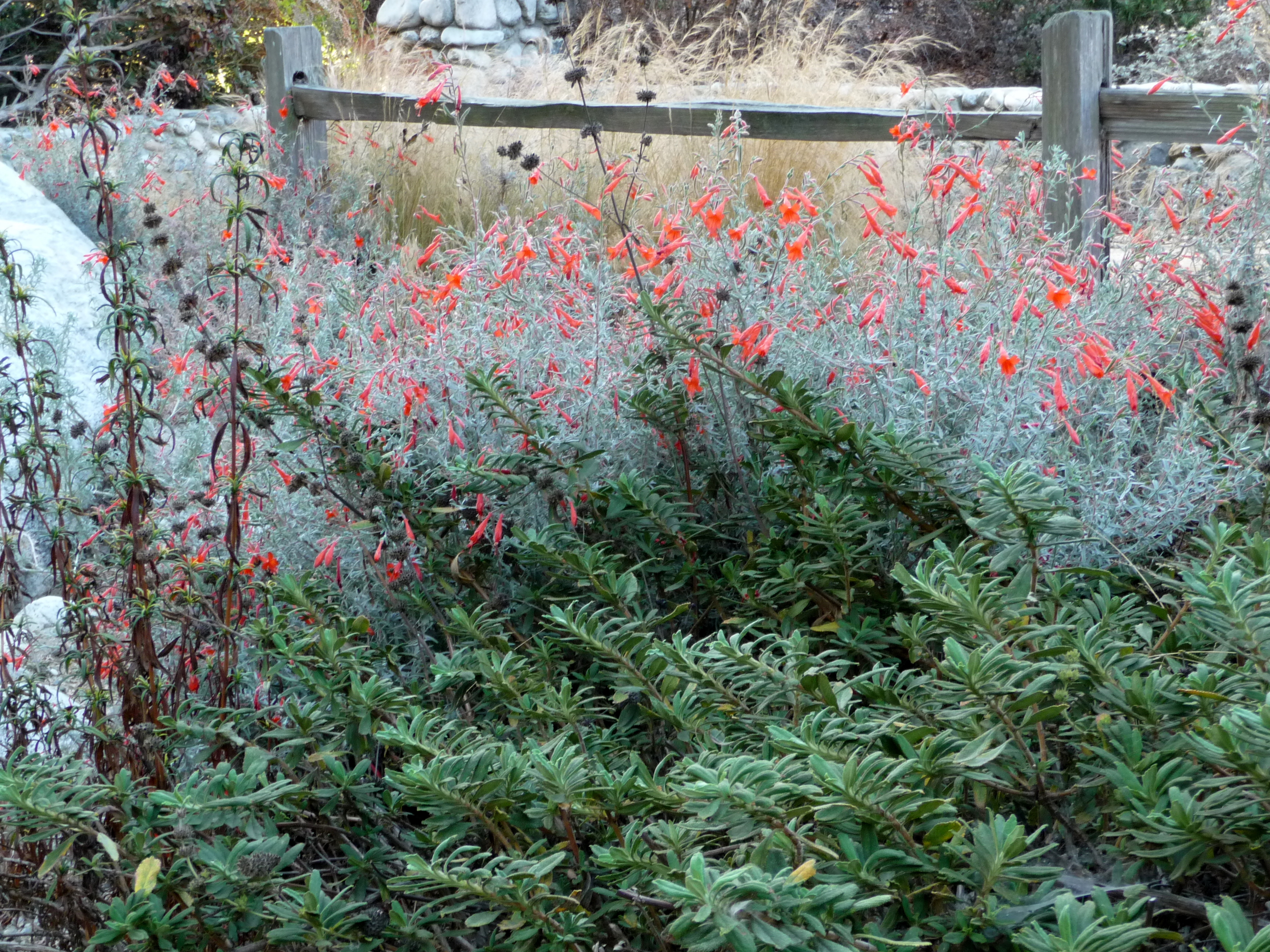
The California Native Plant Society Orange County Chapter presents guest author Dan Songster’s Plant of the Month for September 2025 featuring California Fuchsia ‘Catalina.’
- What: Epilobium californicum ‘Catalina’-California Fuchsia selection
- Type: Perennial (Herbaceous Sub-Shrub)
- Light: Sun
- Soil: Adaptable but prefers well-drained soils
- Water: Drought tolerant
- Common Habitat: On sunny dry slopes, rocky hillsides in Coastal Sage Scrub, Chaparral, and Oak Woodland communities.
When the time comes for them to bloom, California Fuchsias are some of our state’s showiest plants. Definitely a plant of the west, growing from Oregon and Wyoming all the way through California and down into Baja California. It makes sense that there would be a great variety in size, garden behavior, leaf color, and although the most common flower color is orange and orange-red, there are cultivars that include white and salmon.
California Fuchsia’s are deservedly known to native gardeners throughout California for two things; blooming fiercely through the hottest and driest periods of the summer and fall months and for being a wonderful attractor and feeder of hummingbirds. Let’s take a look at one California’s very best of these fuchsia’s, the cultivar named ‘Catalina.’

The Basics
Like most of the “Hummingbird Trumpets,” this plant has intense orange-red flowers which are definitely attractive to those lovely flying jewels. ‘Catalina’ was selected by Mike Evans of Tree of Life Nursery from the Middle Ranch on Santa Catalina Island in 1987 and was introduced by Tree of Life Nursery in 1990.
Unlike most California Fuchsias which spread out and stay low, ‘Catalina’ is an upright “soft” shrub, growing to 3-4 feet tall with nice silvery foliage and large, bright red flowers in late summer and fall. It is a densely branching sub-shrub that has an extended bloom period. Its large size alone makes it different than many others. San Marcos Growers say, “…for those that want a big California Fuchsia, this one is the best!”
Garden Uses
Commonly used in mixed borders, slopes, rock gardens and even containers, planting it in a location where you can enjoy the antics of hummingbirds makes the most sense. Be aware that although taller than all other California Fuchsias, it still spreads by rhizomes, so be careful to place it where it can roam a bit.
As Mike Evans states “The leaves of this beautiful selection are grayer than the typical species, the bloom time is later and longer, and the more upright plants are tolerant of typical garden conditions. Include it in a native border next to a patio to enjoy the flower color and the hummingbird visitors.”

Planting it with other coastal sage scrub favorites makes sense and I bet you can envision ‘Catalina’ fuchsia’s bright color complementing/contrasting with the creamy white of buckwheat flowers. What a sight in our summer gardens.
Torrey Neel mentions she likes, “…to plant it in with summer dormant plants like Artemisia californica or in between Sages, so they get a little color and hummingbird activity in the summer.” What a great idea! This also means the already tall plant can lean on its neighbors and gain an extra few inches in height.
Bert Wilson of Las Pilitas Nursery makes an interesting point, “This California fuchsia doesn’t have as much nectar as some of the other species, but ‘Catalina’ holds it’s flowers longer and still has considerable more ‘hummingbird power’ than most of the fuchsias in the trade…”
Care
This plant loves full sun and is a hardy plant to 5-10 degrees F. In well-drained soils it enjoys some deep watering in summer but still likes drying out between watering. Like most California Fuchsias it does not like soggy clay soils! So, if your soil is clay, it is important to let it go dry during parts of the summer months. ‘Catalina’ has been growing in the clay soils at Golden West College Native Garden for over 20 years and it still performs beautifully.

I have found this, like other big California Fuchsias, to be a fairly brittle plant that breaks easily, so don’t step on it or be too rough when working around it in the garden.
After the first year it is common practice to cut this plant almost to the ground in early winter for a bushier plant and more flowers next season. Sometimes if left unpruned, new growth will appear only at the very tips of the semi-dormant plants, possibly leaving long stems of brown plant material with a small amount of new growth at the ends. The plant re-sprouts after this pruning, when some light pinching in late spring may also be advisable to encourage bushier growth with more flowering points.
By the way, If you notice your Epilobium being nibbled almost to the ground, it likely can be blamed on the appetite of the whitelined Sphinx moth caterpillar, which eventually turns into such a lovely large moth. If you can tolerate the damage, let it be, just as you would with a Monarch butterfly larvae eating your milkweed!

What’s in a Name?
While the genus name used to be known by that wonderful, mouth filling name Zauschneria, (what a ripe word to say!) That was changed to Epilobium with the 1992 Jepson Manual. There have also been changes with the species names as well. In this case the common name of California Fuchsia may be the most accurate, at least until the taxonomists figure things out!
San Marcos Growers notes: “The name Epilobium is considered current but this group of sub-shrubs used to be called Zauschneria and are so different from the other Epilobium, herbaceous plants often called Fireweeds, that many California native plant enthusiast and even the experts often still refer to them as Zauschneria.”

Top Rated Cultivar
‘Catalina’ was one of the highest rated (#3) California Fuchsia in Rancho Santa Ana Botanic Garden’s Horticultural Trials for California Epilobium. This trial that rated 30 named cultivars and two unnamed clones through two seasons of growth from 2003 to 2004 and was rated as third best California Fuchsia’s in October 2005. ‘Catalina’ likely would have rated the highest in this report if not for rambunctious growth and subsequent size. David Fross of Native Sons agrees saying it is, “…Perhaps the best Zauschneria available.”
Do you grow California fuchsia in your garden? Write us back and share your experience with this lovely plant.

Leave a Reply