
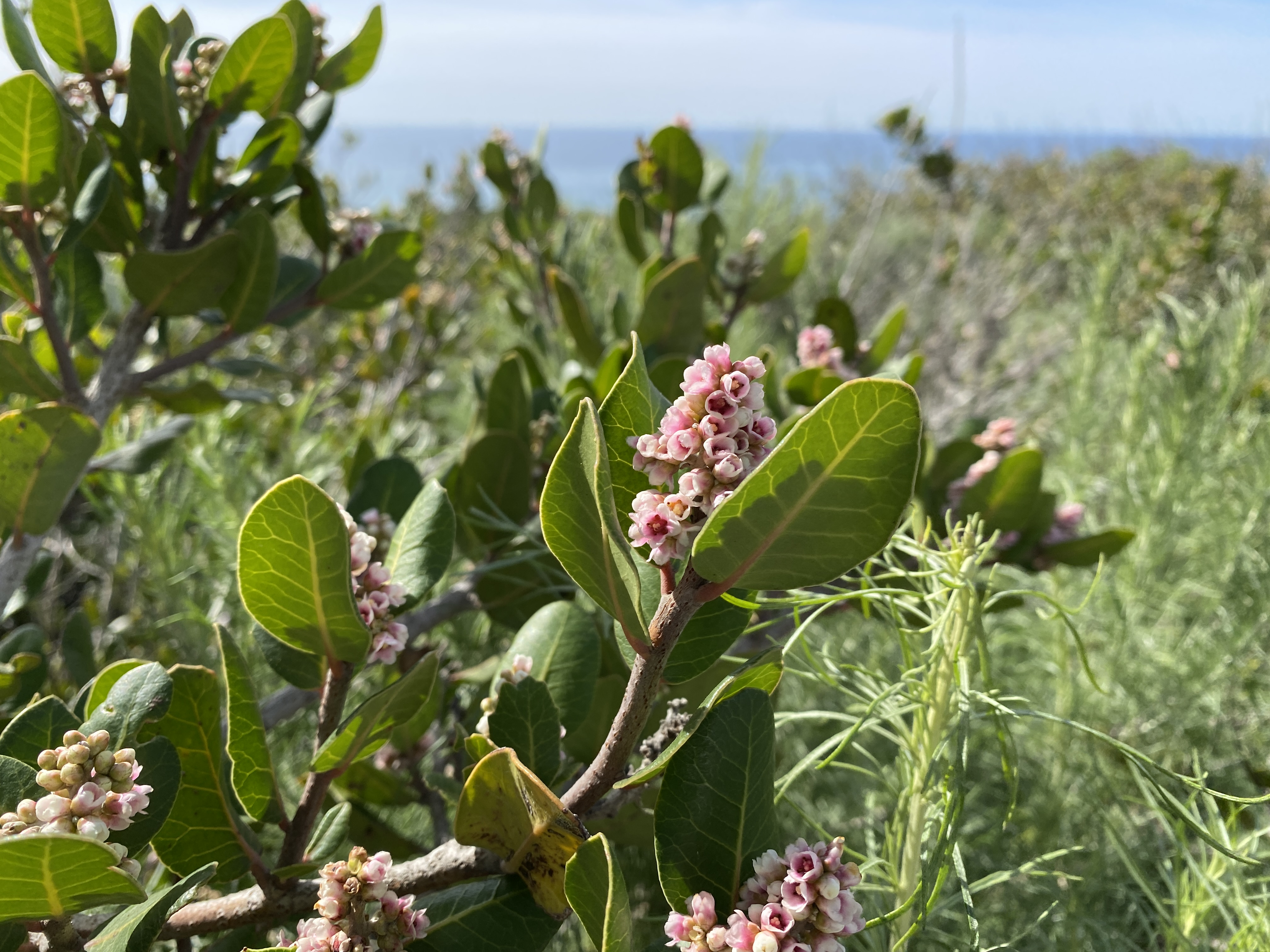
The Orange County Chapter of the California Native Plant Society features our August Plant of the Month article about Lemonade berry by guest author Dan Songster.
- What: Lemonade berry, Lemonadeberry (Rhus integrifolia)
- Type: Evergreen Shrub
- Light: Full sun but can take a touch of afternoon shade inland
- Soil: Well drained (but adaptable to clay soils)
- Water: Drought tolerant
- Common Habitat: Coastal Sage Scrub, chaparral, and edges of oak woodlands near coast
Meet the Lemonade berry, a true Southern California rock star in the world of native shrubs. Not as iconic as the Manzanita or as showy as the Ceanothus but if you love native plants, you have to love this one. Typically, it grows in our dry canyons, often on north-facing slopes or slopes/bluffs facing the ocean from south of Santa Barbara to Baja California, Mexico.

Forget the pretty flowers for this month. Instead, let’s consider a plant that simply lives and provides a green leafy mass regardless of what you throw at it. Lemonade berry can take clay or sandy soils, regular water or no water at all, drizzly fog conditions or bright sunshine, growing untouched or as a sheared hedge. About the only thing limiting its happy and vibrant growth is freezing temps, which here in Orange County, we don’t normally experience!
Description
Lemonade berry is a healthy and large evergreen, reaching a height of 6-10 feet in protected areas, but it can be much shorter along the immediate coast where salt air and on-shore winds can stunt its normally robust growth. It is usually somewhat wider than tall, spreading to as much as 10-12 ft. in diameter in favored spots. Interestingly, it can be kept to a much smaller size with regular pruning (more below).
This plant has flat, leathery leaves, one- to two-inches long, sometimes serrated. The small flowers are white to pink, with five petals and five sepals clustered at the ends of the stems and its ripe fruits are red, hairy, and sticky. The sticky substance covering the fruit tastes like bitter lemons, which gives the plant its name. Lemonade berry commonly blooms from February to April and bees love it during these months.

Garden Uses
Serving every garden function other than being a ground cover, it is an excellent foundation shrub for our lower elevations and is great for hedges, screens, and backdrops, and even espaliered if you want to spend the effort. If allowed to get
One of the questions I am asked frequently is what native to use in a fairly narrow area along a fence where one might like a taller plant for privacy. In such situations, Lemonade berry is one of the best screens. The dense foliage makes it an ideal backbone plant for a screen but it also excels in a mixed hedgerow combined with local Ceanothus species, Catalina and Hollyleaf cherries, and Toyon.
For an additional treat, consider using it as a living trellis by planting Heartleaf Penstemon (Keckiella cordifolia) beneath it, allowing it to wind up through, and in spring, emerging above the green foliage with its striking red/orange flowers! When the Keckiella dies back in summer its “unsightly” branches are hidden by the Lemonade berry’s always rich foliage.
Have a hillside? Lemonade berry’s deep roots are great at holding slope soils and when mixed with a variety of other slope loving natives (think California Buckwheat, Encelia californica, Matilija Poppy, Sages), you have more than just a functional multi-layered root system holding your hillside in place, but also a wonderful habitat garden!

Lemonade berry or Sugar Bush?
Regarding this plant and its cousin Sugar Bush (Rhus ovata), both are commonly used in landscaping or gardening, and can be easily found in nurseries favoring native plants. Which plant should you use if you only have room for one? When landscaping with these two Rhus species, a good rule of thumb is within 5-10 miles of the coast Lemonade berry can be a better choice. More inland, Sugar Bush is more heat and frost tolerant and so may do better.

Care
Plant in full sun with no amendments, giving it space to grow. Water well the first year and then allow it to live on winter’s rainfall alone.
Prune it as you like. Lemonade berry can take repeated shearing (the same hedge has been softening the landscape near the library and gift shop at Santa Barbara Botanic Garden since the 1950’s). Most plants will not respond well to repeated pruning but Lemonade berry does not seem to mind. It is important to note that you can prune without damage anytime the plant is actively growing (which is almost always). If you prune it in fall months you will likely lose some of that year’s winter/spring flowers.

A novel approach to pruning is advanced by the renowned Dr. Constance M. Vadheim, “You can actually have the best of both worlds. If a formally clipped hedge is needed (to face the neighbors), prune one side formally and the other (facing your garden) semi-formally. This will often please all parties. You needn’t be too worried about how to prune a Lemonadeberry – it’s a very forgiving plant.”
And if this plant becomes too big or too lanky? Give it a hard pruning, even to the ground in late fall or early winter, and this plant (using its established root system) will re-sprout new shoots rapidly!
Pruning Protection
Be aware of the Rhus part of the name–it is the same Genus classification as Poison Oak (until Poison Oak was reclassified). Use care when pruning as this sumac relative has sap that can cause a rash. Even if you are not sensitive to its sap, you will find wearing gloves is smart since it can stain your skin. Even your pruning tools will need a good scrub after working on this plant.

Plant Uses
The Cahuilla and other California native people ate the fruits of the lemonade berry raw. They soaked the berries in water to make a beverage and ground the dried berries into flour for a mush or to add to soup. It also has medicinal uses. If you do more research, you will find many uses of this plant by native peoples.
For those of us with a dislike of sudden plant name changes, the San Marcos Growers Website warns us it is possible the Genus name Rhus may change. “The name for this plant according to the Plant List (the collaboration between the Royal Botanic Gardens at Kew and Missouri Botanic Gardens) is Schmaltzia integrifolia but treatment in the recent Jepson Manual has the current name as Rhus so we are sticking with this at least for the time being. The name Schmaltzia was given to the genus by French botanist Nicoise Auguste Desvaux (1784-1856) to honor Constantine Samuel Rafinesque (1783-1840), also known as Rafinesque-Schmaltz who, as a Turkish born multi-disciplinarian, made notable contributions in the nineteenth century to botany, zoology, anthropology and linguistics.”
For the absolutely most complete look at this useful native plant, check out this post on Mother Nature’s Backyard Blogspot.
Do you have Lemonade berry growing in your garden? Send us a photo and share your experience.


Leave a Reply